"Run Google Ads. Try LinkedIn. Maybe do some retargeting."
This isn't a strategy, and it's why so many B2B SaaS companies spend thousands on PPC campaigns and can't tell six months later whether it's working.
We recently built a full PPC strategy from scratch for Helply, an AI support agent for B2B SaaS companies. They had a $10K/month budget and were brand new to paid.
We’ll use that as a running example throughout this piece. Not because every SaaS brand should copy it, but because seeing the reasoning behind real decisions is more useful than reading another "10 PPC tactics" listicle.
This post walks through the decisions you actually need to make to build a successful SaaS PPC campaign that drives pipeline, in the order you need to make them.
1. Define What "Working" Means Before You Spend Anything
Most SaaS PPC strategies fall apart before they start, due to vague goals like "generate leads” or "increase awareness."
The problem is that these "goals" give you nothing to optimize against.
Before you touch a single ad platform, you need two numbers:
A specific acquisition target. Not leads. Not MQLs. We're talking about paying customers per month acquired from paid channels.
A blended CAC ceiling that makes the math work against your LTV.
That's it. Everything else in your SaaS PPC strategy flows downstream from those two numbers. It doesn’t mean you need to be hitting these numbers from day one, but they’re the guardrails to aim and optimize for.
How we set this for Helply:
This client's portfolio growth targets required 20+ new customers per month from paid channels. Given Helply's pricing and expected LTV (customer lifetime value), a blended CAC of $600 or less made paid acquisition profitable from day one. Those two numbers became the north star for every decision that followed.
Apply this to your company:
Your numbers will be different, but the principle is the same. If you can't state the specific number of customers you need and the CAC needed to make them profitable, you're not ready to run paid ads.
2. The Two Layers: Demand Capture and Demand Generation
Every SaaS PPC strategy breaks down into two distinct functions.
Demand capture converts people who are already looking. They're searching Google for "AI support agent," comparing tools, reading reviews, typing a competitor's name into the search bar because they're frustrated with it. High intent. Fastest path to revenue.
Demand generation gets in front of people who aren't looking yet but fit the profile (i.e., your target audience, or your ICP). They're the right buyer at the right kind of company, but they haven't started shopping. You're building awareness, creating familiarity, planting the seed so that when they do start looking, your name is already in their head.
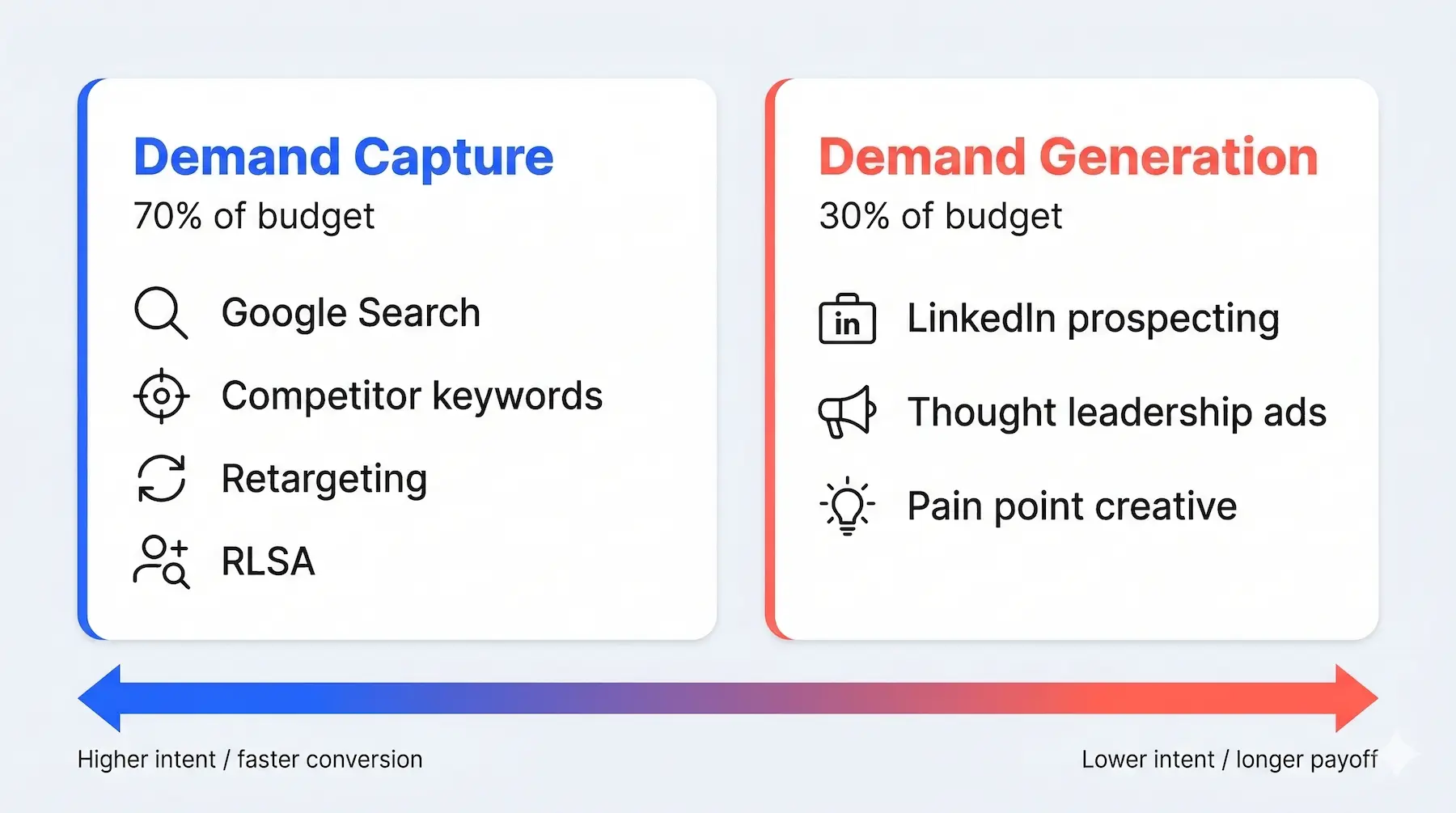
Most SaaS businesses get the balance wrong. They either go all-in on capture and plateau fast, or spread budget evenly across both and burn cash on top-of-funnel before proving the conversion engine works.
Almost always start with capture. Prove the conversion engine works, then fund demand gen from the confidence and data that capture generates.
How we weighted this for Helply:
70% demand capture
30% demand generation
That split was deliberate because people are actively searching for AI support agents. They're typing competitor names into Google because they're frustrated with their current tool.
Capture them first. Demand gen runs alongside it to fill the top of the funnel, but it doesn't eat most of the budget until the capture engine is proven.
Apply this to your company:
The ratio depends on your market. If you're in a category with high existing search volume (project management software, CRM, email marketing), lean heavier into capture.
If you're creating a new category or the search volume is thin, demand gen takes a bigger share earlier. The mistake is not choosing deliberately.
3. Channel Selection: Why the Order Matters More Than the List
The channels are pretty predictable. Google. LinkedIn. Meta. Maybe YouTube. Check, check, check.
The real decision is sequencing. What you launch first, what you delay, and how each channel supports the funnel.
Demand Capture and Demand Generation Work as One System
Paid acquisition in B2B SaaS is not channel-first. It’s intent-first.
Some channels capture existing demand. Others create and shape it. Both need to run together, but not at the same time or with equal weight from day one.
Demand capture (high intent)
Google Search is the foundation. It converts buyers who are already looking for a solution.
Within Google Search, the structure matters. Different intent requires different campaigns with different messaging and separate budgets. For Helply, we built separate ad campaigns for:
Primary competitor keywords (Chatbase, the biggest direct competitor). Dedicated budget, specific messaging around Helply's differentiators: action-based resolution instead of just Q&A, a 65% resolution guarantee, and stronger hallucination guardrails.
Legacy tool frustration keywords (Zendesk alternatives, Intercom too expensive). Different intent entirely. These searchers aren't shopping for an AI agent. They're frustrated with their current tool. The messaging reframes the problem.
High-intent category keywords (AI support agent, AI helpdesk). People who already know what they want and are deciding who to buy it from.
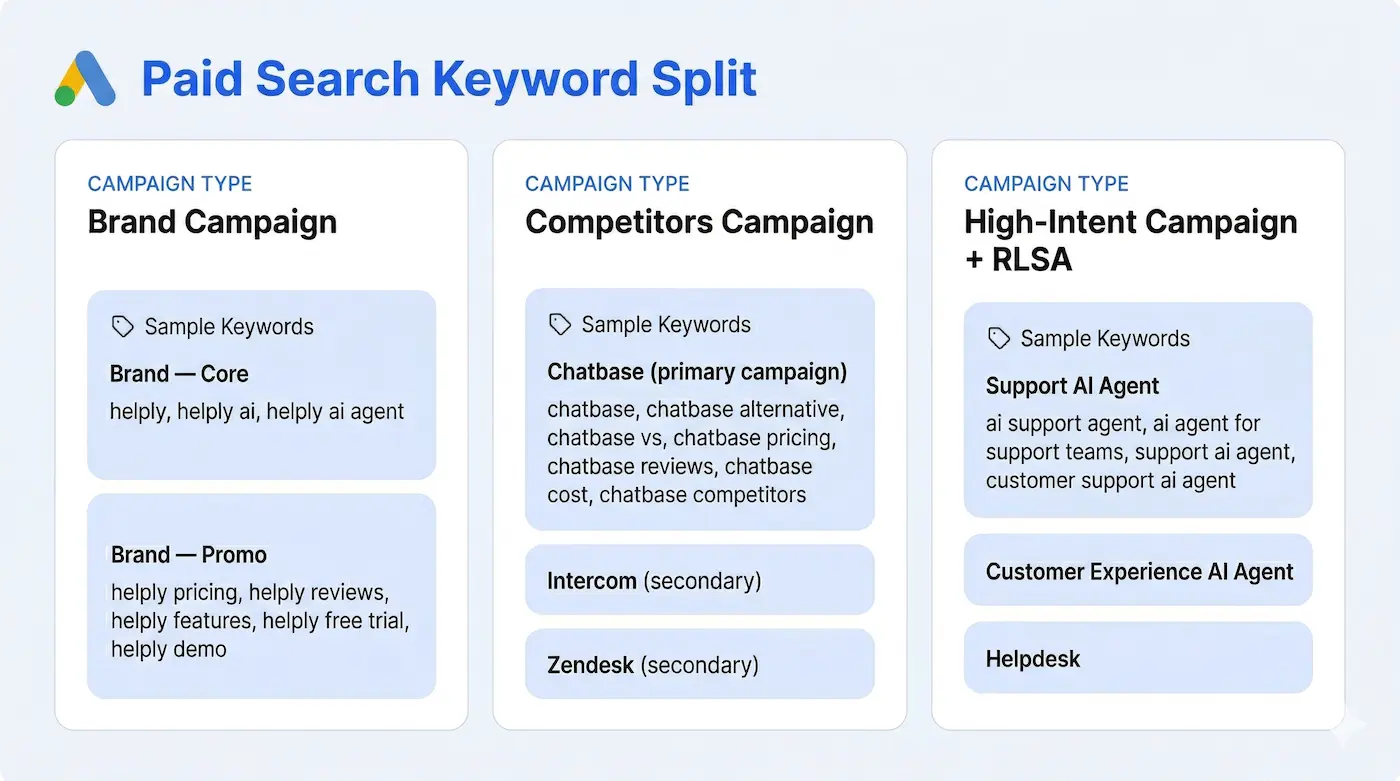
Retargeting sits alongside this. LinkedIn, Meta, and YouTube reinforce exposure for users who have already visited the site. The goal is familiarity and trust, which drives conversion over time.
Demand generation (creating intent)
The aim here is to expand the pool of future buyers.
LinkedIn is the primary channel for most B2B SaaS companies because it allows precise targeting of ICP roles. For Helply, that included SaaS operators, CX leaders, and founders.
Instead of pushing product-led ads, we scaled what was already working organically. Founder-led, build-in-public content became paid distribution. The ads didn’t force conversion. They built awareness and credibility with the right audience.
This is what makes demand generation effective. It introduces the problem, shapes how buyers think about it, and positions your product before they start searching.
The Sequencing Principle
Meta's prospecting algorithm and Google's Performance Max are both AI-driven. They optimize based on conversion data. Launch them cold, with zero pixel data, and that's wasted ad spend.
The smarter play is to start Meta as a retargeting channel first. Let it collect data on who actually visits and converts. Then expand into prospecting once the algorithm has a real signal to work with.
Same logic for PMax. Hold it until Google has enough conversion history to make smart decisions.
What we deliberately held back for Helply:
Meta prospecting at launch. Not because Meta doesn't work for B2B. It does. But launching cold Meta campaigns before the pixel has conversion data is like hiring a salesperson and not telling them who the customer is.
Google Performance Max until month three. PMax is a black box that needs conversion data to function. Feed it nothing, and it optimizes for nothing.
Reddit, Bing, and X. All potentially interesting for B2B SaaS. All deliberately held back until the core engine is proven.
The discipline to not do everything at once might be the single most important decision in a SaaS PPC strategy. Channel sequencing, doing things in the right order rather than all at the same time, matters more than any individual tactic.
4. Creative Angles: What to Say and to Whom
Your SaaS PPC strategy also needs to define ad messaging. Most companies default to product-feature messaging ("AI-powered support agent with 24/7 availability") and wonder why click-through rates plateau.
1. Pain points (top of funnel, cold audiences)
Start with the problem, not the product. Your ad copy (and visuals) should describe the reader's daily reality back to them. High ticket volume. Rising support costs. Slow response times. Hiring extra support agents to keep up.
This works on cold audiences because it builds immediate relevance, with no product knowledge required.
How to implement:
Use on LinkedIn prospecting and cold Meta campaigns
Pair with broad ICP targeting (job titles, industries)
Optimize for engagement and early-stage conversion signals (video views, site visits)
2. Differentiators (mid-funnel, consideration stage)
Once awareness exists, the question becomes: why choose you? What specifically makes your product different? Not "we're an AI helpdesk" (every startup says that). What are the concrete proof points that create preference?
Generic positioning always gets ignored. Specific, verifiable proof points create preference.
How to implement:
Use in retargeting campaigns and high-intent search ads
Segment audiences based on behavior (site visitors, demo page views)
Align messaging to landing pages that reinforce the same proof points
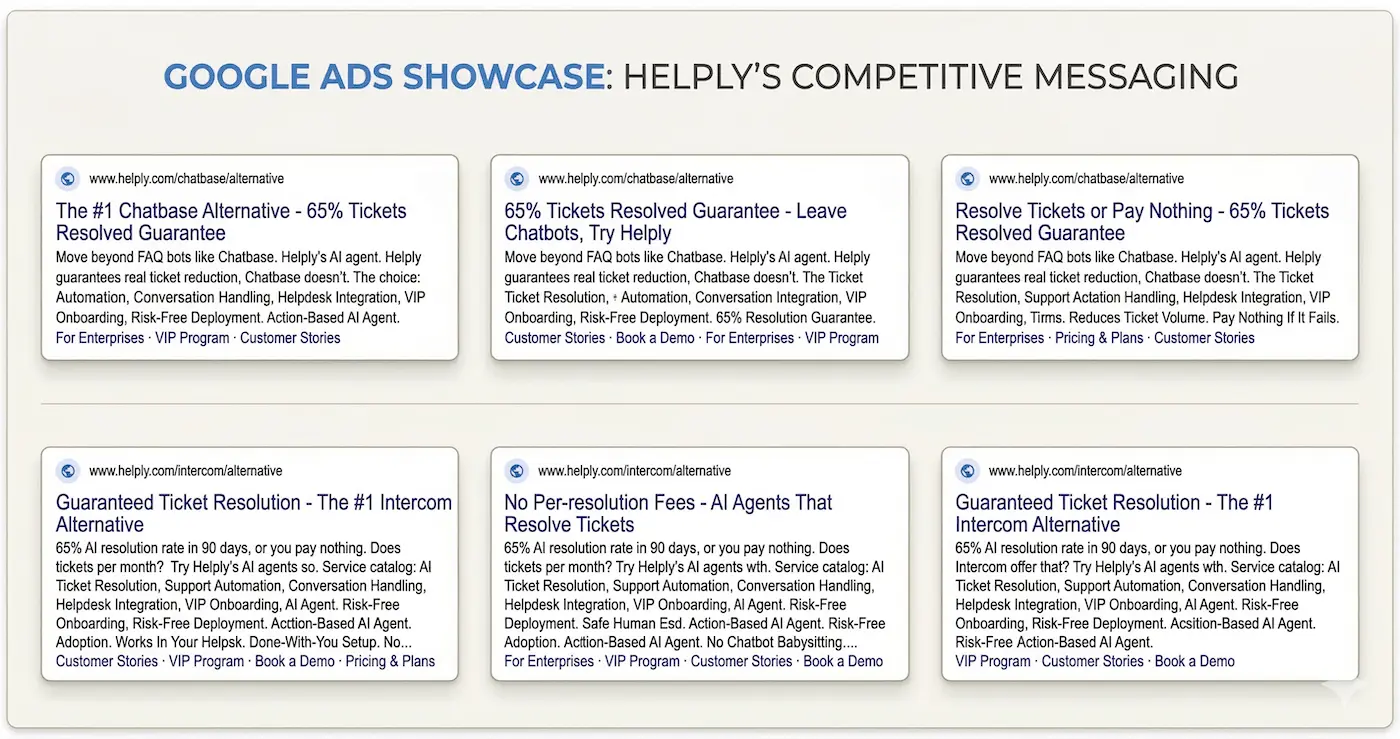
3. Comparison/opportunity cost (bottom of funnel, decision stage)
At this stage, buyers are weighing options or delaying a decision. The message shifts to consequences. What is the buyer losing by staying with the status quo?
Inefficiencies of legacy tools
Time lost to manual workflows
Cost of maintaining the status quo
You don’t need to name competitors directly here. The goal is to make inaction feel expensive.
How to implement:
Use in bottom-of-funnel retargeting and competitor search campaigns
Focus on conversion-driven CTAs (book a demo, start trial)
Tighten frequency and recency to stay visible during decision windows
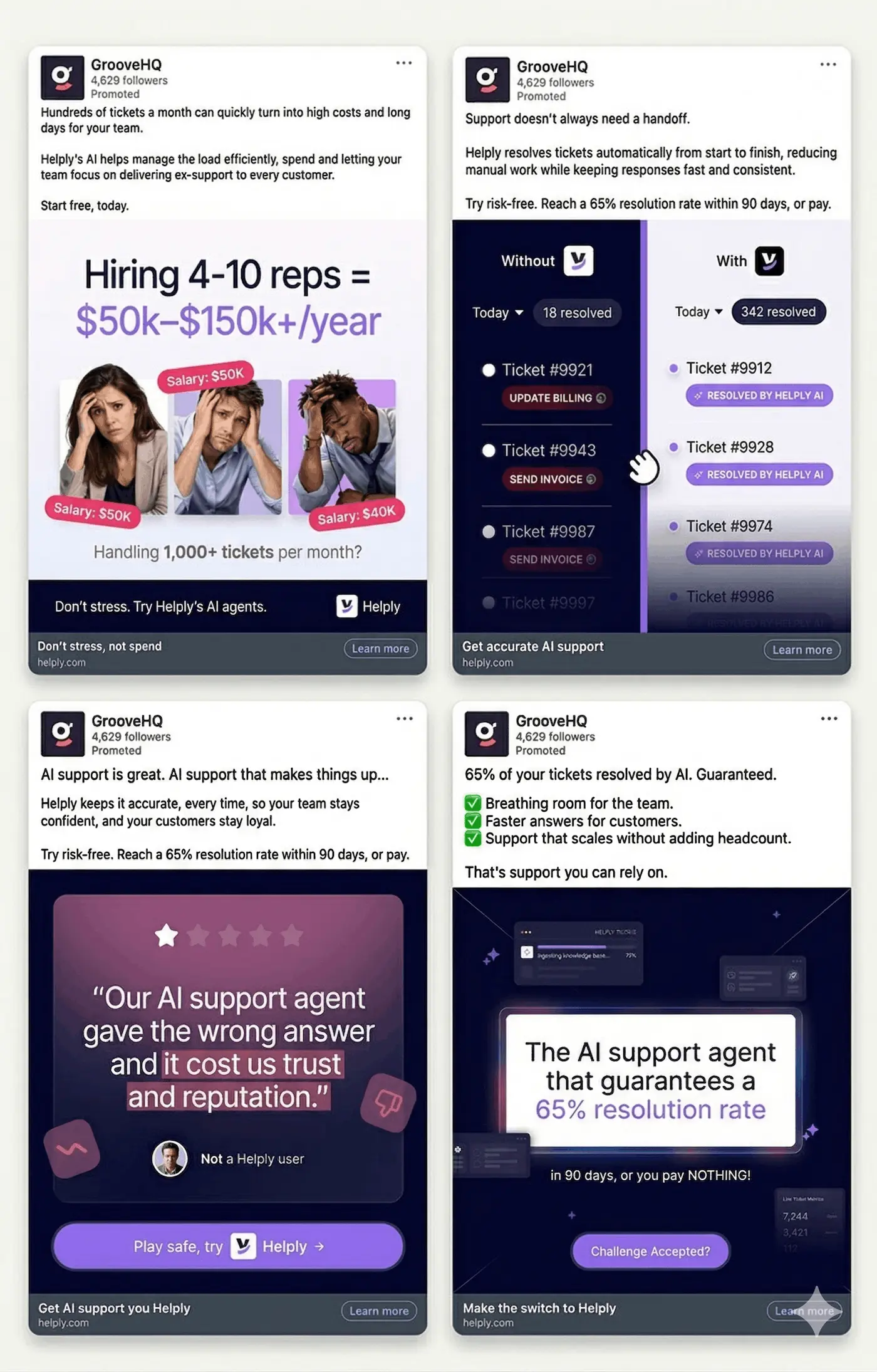
The strategic layer
Each angle should run simultaneously across different audiences, with the budget weighted toward the stage that needs the most support.
Pain points create awareness ("this is my problem")
Differentiators create preference ("this solution is different")
Comparison creates urgency ("I'm losing something by waiting")
This is where most SaaS PPC strategies break. They rely on one type of messaging and expect it to work across every stage. Performance improves when creative matches intent, and when messaging evolves as the buyer moves closer to a decision.
The message should carry through to your landing pages
Your creative strategy can't stop at the ad. The landing page the ad sends traffic to needs to continue the same angle.
A pain point ad that lands on a generic product page breaks the chain, and you lose a potential customer. We build dedicated landing pages for each creative angle, so the message stays consistent from ad impression to conversion.
That's a whole topic in itself, but the principle is simple: The ad makes the promise; the landing page delivers on it.
5. Budget Allocation: Where the Money Actually Goes
Let's keep it simple here. The highest-intent channels get the most money.
This sounds obvious. But most companies either split budgets evenly across channels or over-index on whichever channel their CEO saw a LinkedIn post about.
A framework for allocation
Lead with demand capture (50-70% for most SaaS companies starting out)
Fund retargeting as a consistent baseline (it serves double duty: conversion and algorithm training)
Allocate demand gen based on how much existing search volume your category has
Keep a meaningful reserve for reallocation — the starting allocation is a hypothesis, not a permanent plan
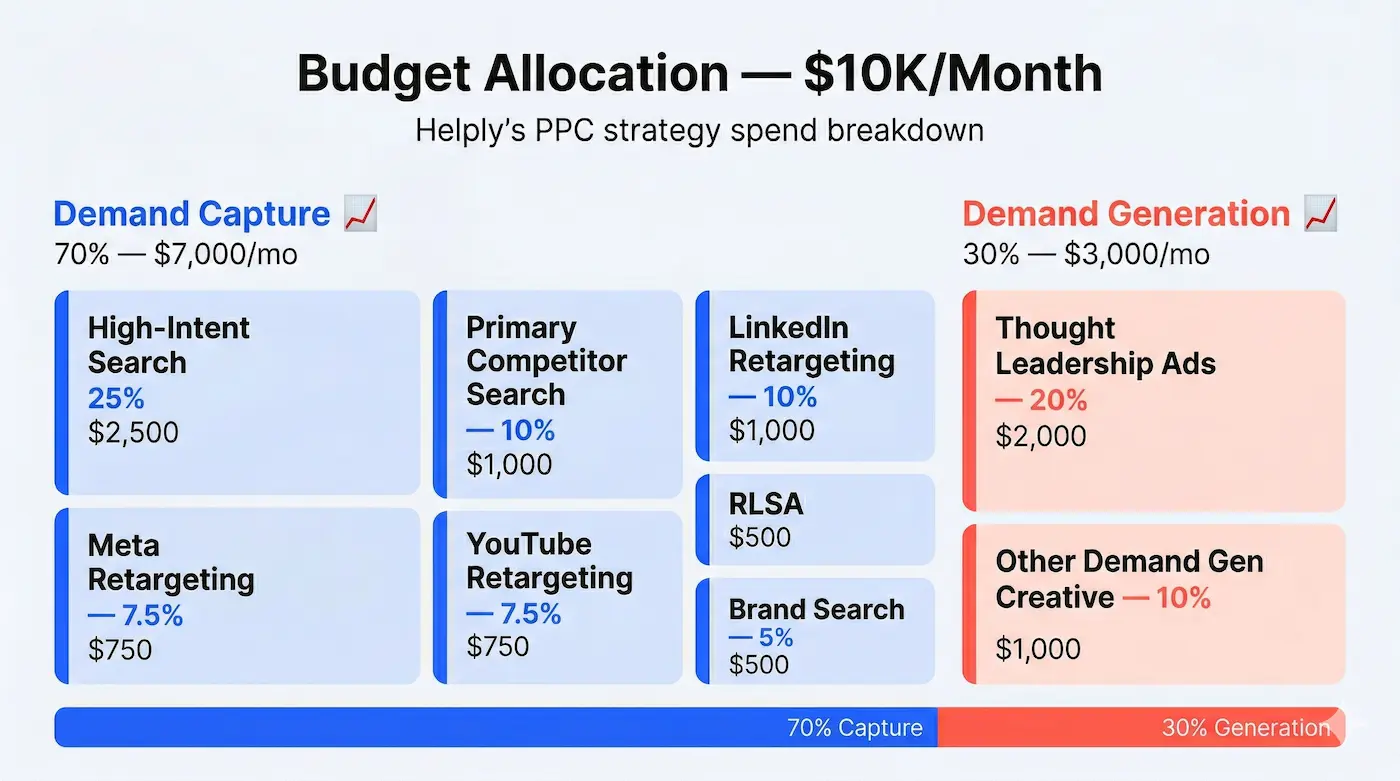
How we allocated Helply's $10K/month:
Demand generation (30% of total):
Thought leadership ads: 20% of total budget
Pain point, differentiator, and comparison creative: 10%
Demand capture (70% of total):
High-intent search: 25% (largest single allocation)
Primary competitor search (Chatbase keywords): 10% (separate budget because different intent needs different messaging)
LinkedIn retargeting: 10%
Meta retargeting: 7.5%
YouTube retargeting: 7.5%
RLSA: 5%
Brand search: 5% (defensive, to make sure nobody bids on the Helply name)
Apply this to your company:
Your split depends on category maturity, existing brand awareness, and the size of the high-intent search pool.
A SaaS company in a crowded category like project management might put 80% into capture. A company creating a new category might flip it to 60% demand gen.
The allocation is a starting hypothesis. Build in aggressive reallocation at 30 and 60 days based on actual performance data. If Thought Leader Ads massively outperform high-intent search, the budget shifts. If competitor search converts at half the cost of everything else, it gets more. Where you start is not where you'll end up.
6. Attribution: The Direct Response Trap
No SaaS PPC strategy is complete without addressing how you'll measure campaign performance (i.e., what's actually working).
Most SaaS marketers default to last-click attribution because it's what ad platforms report. This is the direct response trap, and it systematically destroys good marketing strategies
Remember, SaaS buyers typically go through longer customer journeys. Here's what happens:
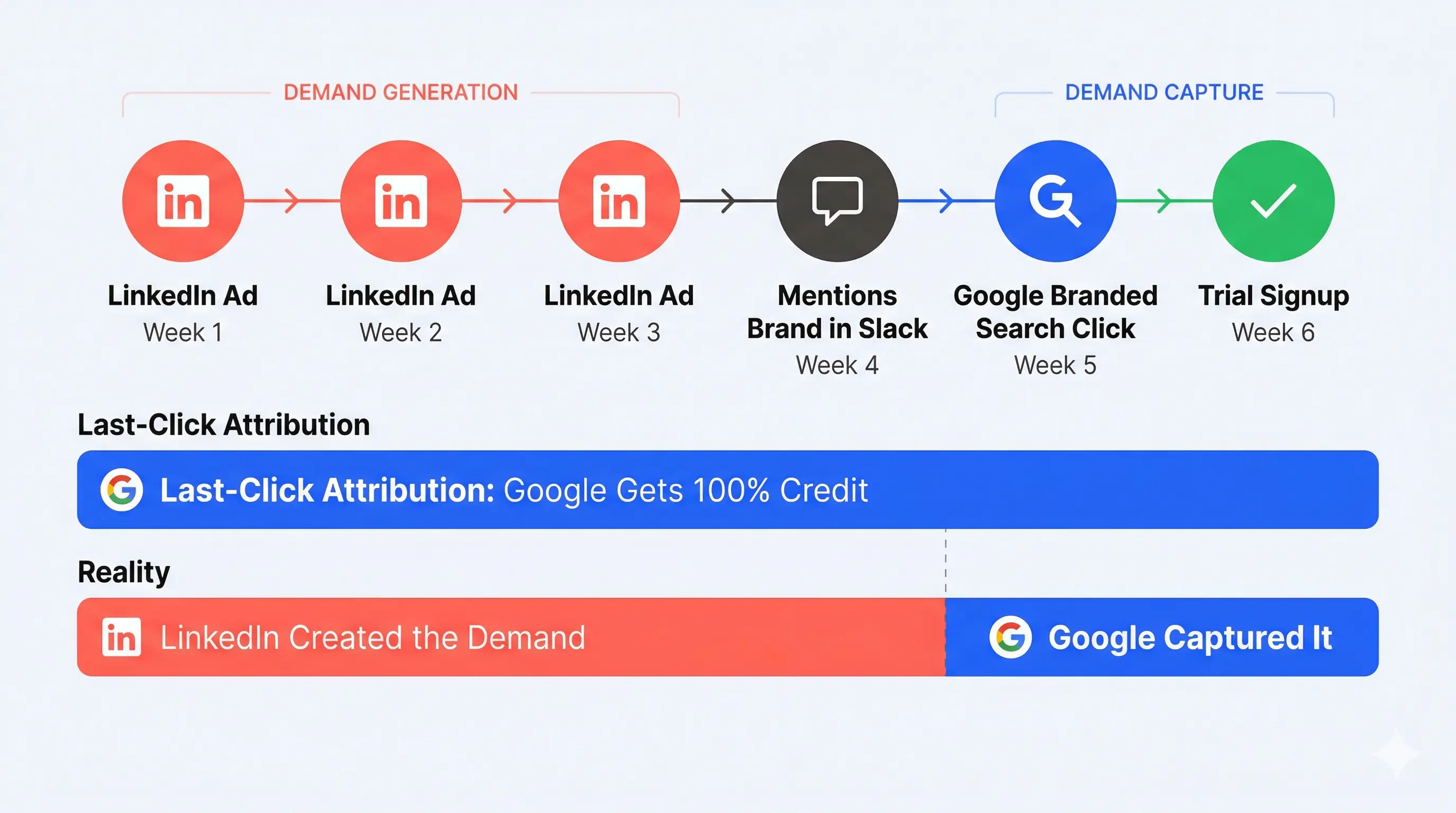
A prospect sees your LinkedIn Thought Leader Ads six times over three weeks.
They start recognizing your brand.
They mention you in an internal Slack thread.
Two weeks later, they search your brand name on Google, click a branded search ad, and sign up for a free trial.
Last-click attribution gives Google 100% of the credit. LinkedIn looks like it did nothing. If you make budget decisions based on this data, you starve the top of the funnel and wonder why your capture campaigns plateau three months later.
What to do about it:
Accept that perfect attribution doesn't exist in B2B SaaS sales cycles that run 3-12 months with multiple decision-makers
Use self-reported attribution ("how did you hear about us?") alongside platform data. It's imperfect but directionally valuable
Track branded search lift as a proxy for demand gen effectiveness. If branded searches increase after you start LinkedIn prospecting, that's signal
Connect ad platforms to CRM data so you can see which channels drive pipeline, not just clicks. Tools like Fibbler and Factors connect ad spend to actual deal progression
If you're optimizing exclusively for what last-click can prove, you're optimizing for a fraction of what's actually working.
The key takeaway? Don't let imperfect measurement kill channels that are working but can't prove it in a spreadsheet.
The 30/60-Day Plan: What Happens After Launch
The plan you launch with is version one. The real strategy is the system you build for learning and adapting.
Days 1-30: Build the foundation
The first month is about getting everything live, tracking properly, and generating data. Resist the urge to optimize too early. You need statistical significance, not gut reactions.
Launch all capture campaigns (Google Search, retargeting across platforms)
Launch demand gen (LinkedIn prospecting, Thought Leader Ads)
Verify all conversion tracking fires correctly (this sounds basic, but broken tracking wastes the entire first month of data)
Collect baseline metrics: CPC, CTR, conversion rate, cost per trial, cost per customer
Document initial creative performance. Which angles and formats get traction?
Days 30-60: Optimize and expand
This is where it gets aggressive. You now have a month of real data. Use it.
Cut underperforming ads and keywords. Not everything will work. That's expected. Kill what's not performing and reallocate that budget.
Double down on winners. If competitor search is converting at half the CAC of everything else, it gets more budget.
Test new creative angles. The initial pain point ads worked? Good. Now test variations. Different copy, different visuals, different formats.
Expand into held-back channels. If the core engine is working, month two or three is when Meta prospecting, PMax, and additional platforms come online. They now have data to work with.
The goal by day 60 is a working acquisition engine with clear data on what's performing, what's not, and where the next dollar of budget should go. Not a finished system. A learning system.
Work With Hey Digital
We build strategies like this for B2B SaaS companies at every stage, from Series A companies launching paid for the first time to Series C companies restructuring campaigns that stopped producing pipeline.
Every account is led by a senior B2B SaaS strategist, supported by an in-house creative team that produces the ads, landing pages, and video that the strategy requires. We use Fibbler and Factors to connect ad data to CRM pipeline, so reporting shows deal progression and revenue contribution, not just clicks and impressions.
We also run paid ads for our own pipeline. We use the same playbooks, the same platforms, and face the same challenges. That first-hand operational experience is something most agencies can't offer.
If you're building a SaaS PPC strategy and want a team that's done this 200+ times for B2B SaaS companies, including Instantly, PostHog, Toggl, and Hotjar, let's talk.
FAQs
What is PPC for SaaS?
SaaS PPC (pay-per-click) is paid advertising used by B2B SaaS companies to generate pipeline and revenue, not just traffic or leads.
It typically spans platforms such as Google Ads, Bing Ads, LinkedIn Ads, and Meta, with each channel playing a different role across the funnel:
Paid search (Google, Bing): captures high-intent demand from buyers actively looking for solutions
Paid social (LinkedIn, Meta): builds and nurtures demand within target accounts
Retargeting: converts engaged users who didn’t act on the first touch
What makes SaaS PPC different is the focus on commercial outcomes. Campaigns are measured against pipeline, CAC, and payback period, not clicks or form fills.
How much should a B2B SaaS company spend on PPC?
There’s no fixed number. Always start with your CAC target and reverse-engineer the budget. If you need 20 customers per month at a $500 CAC, that implies ~$10K/month in spend, assuming conversion rates hold.
Most Series A–B SaaS companies invest between $10K and $50K/month. The right budget is where LTV and CAC stay aligned.
Should I start with Google Ads or LinkedIn Ads for SaaS PPC?
Start with the channel that captures existing intent. For most SaaS companies, that’s Google Search. Buyers are already looking for solutions. LinkedIn supports demand generation by reaching the right audience earlier in the journey.
In practice, both work best together, with early spend weighted toward search.
How long before SaaS PPC campaigns produce results?
Expect usable data within 30–60 days and more stable performance by month three. The first phase builds data. The second refines targeting and creative. By month three, you should see consistent pipeline signals.
What’s the biggest mistake in SaaS PPC strategy?
The biggest mistake in SaaS PPC strategy is optimizing campaigns for the wrong metrics (especially vanity metrics!), especially when the cost of SaaS growth is growing.
Clicks, CTR, and cost per lead don’t reflect business impact. The focus should be on customer acquisition and qualified leads, and within that, the cost per opportunity and cost per customer.
Without CRM visibility, campaigns drift toward low-quality volume.
How do I know if my SaaS PPC strategy is working?
When measuring PPC performance, you should focus on three signals:
CAC is trending toward your target
Paid channels generate qualified pipeline
Branded search demand is increasing
These indicate that both demand capture and demand generation are working together.

CEO @ Hey Digital
About the author
Dylan Hey is the CEO and co-founder of Hey Digital and Hey Design, where he helps SaaS companies scale through performance marketing and creative strategy. He has built a globally distributed agency working with 200+ SaaS brands.
View LinkedIn
Blog