Choosing the right approach to paid acquisition, or the right partner to run it, comes down to one thing: proof.
Most agencies can talk about channels and best practices, or show off fancy charts and dashboards. What’s harder to assess is whether their methodology translates into pipeline and revenue for SaaS companies.
That’s where case studies matter.
They show how PPC campaigns perform under real conditions, detailing how this SaaS marketing strategy impacts customer acquisition, cost efficiency, deal value, and overall growth.
The case studies below show how we’ve worked with SaaS companies to turn paid ads into a reliable growth channel.
Why PPC Is a Key Growth Channel for SaaS Companies
For SaaS brands, PPC is one of the most direct ways to generate pipeline.
Unlike channels that take time to compound, paid ads allow you to capture existing demand and reach high-intent buyers when they’re actively looking for a solution. Most campaigns target Google Ads, LinkedIn Ads, Meta Ads, and YouTube.
This combination is what makes PPC so effective in B2B SaaS. It supports both:
Demand capture through high-intent search campaigns
Demand generation through targeted social and retargeting campaigns
When executed well, PPC creates a structured flow from first interaction to pipeline, with clear visibility into performance at each stage.
It also gives SaaS companies control and the ability to optimize in depth. You can test messaging, refine targeting, and scale what works, all while measuring impact against CAC, conversion rates, and revenue.
The case studies below show how this plays out in practice across different SaaS companies, challenges, and channels.
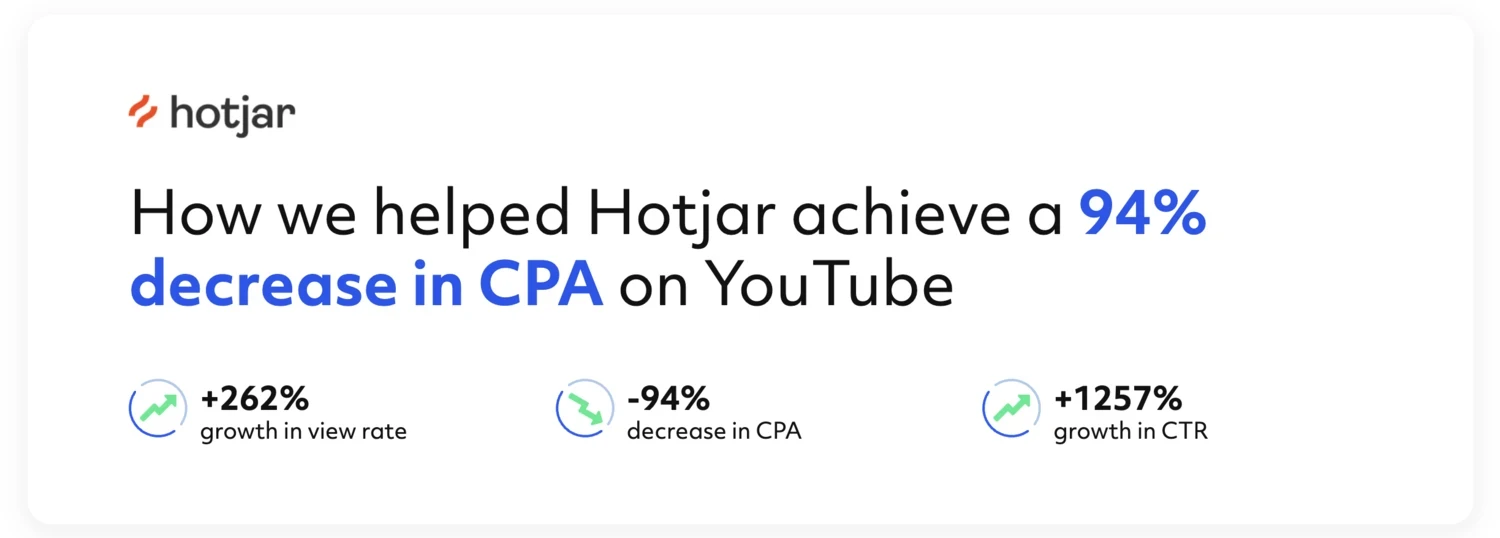
1. Hotjar: Reduced YouTube Ad CPA by 94%
Hotjar wanted to expand into YouTube as a top-of-funnel channel while maintaining efficiency across paid acquisition.
The challenge wasn’t just running YouTube ads. It was proving whether the channel could reach the right audience, drive engagement, and contribute to meaningful growth without inflating acquisition costs.
The Challenge
Hotjar had a strong understanding of its ICP and an established marketing function. The goal was to test whether YouTube could:
Reach high-value audiences earlier in the funnel
Improve engagement with the brand
Drive efficient account creation at scale
To do this, campaigns needed to move beyond broad awareness and deliver measurable performance against existing benchmarks.
The Approach
The strategy focused on rapid experimentation and refining both targeting and creative.
Initial campaigns tested keyword-based targeting, but performance fell short of expectations. This created a clear baseline and highlighted gaps in targeting and messaging.
From there, the approach evolved:
UGC-style creative for prospecting. Short explainer videos were introduced to better capture attention and communicate value quickly.
Granular YouTube placements. Over 1,000 relevant channels were identified based on high-value keywords and ICP alignment.
Custom intent audiences. Campaigns targeted users based on relevant search behavior, running alongside placements as structured tests.
This combination of tailored targeting and creative experimentation improved engagement and drove stronger conversion signals.
The Results
94% decrease in CPA
1257% increase in CTR
262% increase in view rate
By refining targeting and creative, YouTube became a viable acquisition channel rather than just a branding exercise.
Key Takeaway
YouTube can be an effective channel for SaaS companies when treated as a performance channel. With the right targeting, creative, and testing approach, it can drive both engagement and efficient acquisition at scale.
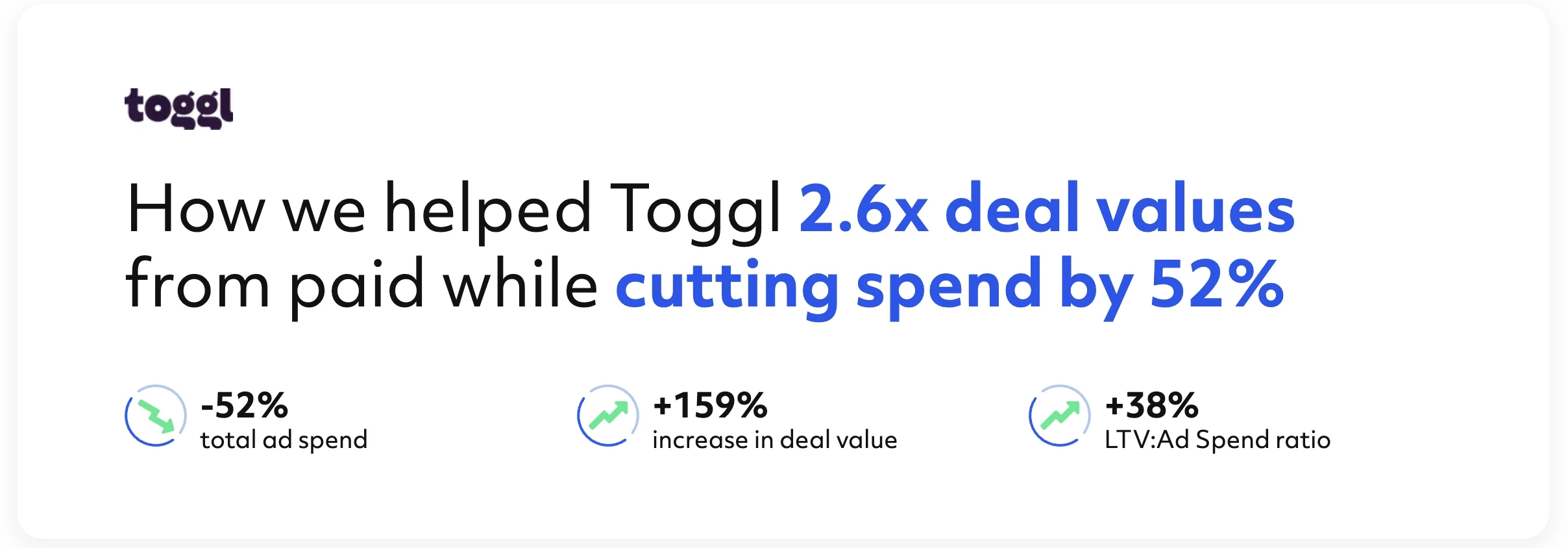
2. Toggl: Increasing Deal Value While Cutting Paid Spend
Toggl needed to prove that paid acquisition could be a viable growth channel.
Despite having strong product-market fit and organic traction, previous paid efforts had underperformed. Leadership questioned whether PPC was worth the investment at all.
The Challenge
Toggl’s existing paid setup lacked structure, targeting precision, and experimentation.
Campaigns were limited to Google Search, with:
Broad targeting and weak segmentation
Little variation in creative or messaging
Minimal testing or iteration
Performance remained flat, and internal confidence in paid acquisition dropped. The goal was bigger than to improve results; it was to prove that paid could drive meaningful pipeline and revenue.
The Approach
The strategy focused on rebuilding paid acquisition from the ground up, with a clear emphasis on efficiency and commercial outcomes.
Tighter ICP targeting. Campaigns were restructured around clearly defined audience segments, focusing on higher-quality prospects rather than volume.
Channel expansion. Paid activity moved beyond search into LinkedIn, Reddit, and YouTube, allowing for both demand capture and demand generation.
Creative and messaging refresh. New creative and messaging were introduced to better align with Toggl’s positioning and engage target audiences more effectively.
Structured experimentation and collaboration. Regular testing, reporting, and feedback loops ensured campaigns evolved quickly, with both teams aligned on performance and direction.
This shift turned paid acquisition from a static channel into a structured, iterative growth system.
The Results
52% reduction in total ad spend
159% increase in deal value (2.6x growth)
38% increase in LTV to ad spend ratio
52% decrease in cost per closed deal
Paid acquisition moved from a questionable investment to a profitable growth channel. With improved targeting and strategy, lead quality increased significantly, and closed-won deals became more valuable.
Key Takeaway
Paid ads don’t need more budget to perform. They need better structure, targeting, and alignment with revenue outcomes. When done right, SaaS companies can reduce spend while improving deal quality and overall return.
3. Pitch: Increasing Signups While Lowering CPA
Pitch wanted to scale paid acquisition while reducing inefficiencies across existing campaigns.
Although they were already investing in paid channels, performance was inconsistent. CPA was high, Facebook performance was declining, and previous attempts at Google Ads had failed to deliver results.
The Challenge
Pitch relied heavily on Facebook Ads, but performance had plateaued.
CPA was increasing
Creative fatigue had set in
Google Ads had previously underperformed
Monthly signup targets were difficult to hit
The goal was to improve efficiency on existing channels while proving that new channels, particularly Google, could drive meaningful results.
The Approach
The strategy focused on improving performance within Facebook while carefully expanding into paid search.
Creative refresh on Facebook. New ad creatives were introduced to replace saturated campaigns, immediately improving engagement and reducing CPA.
Gradual expansion into Google Ads. Instead of scaling aggressively, campaigns started with a small set of high-intent search terms, particularly competitor keywords.
Channel reallocation based on performance. Budget was shifted based on results, allowing Google to scale once performance was validated.
Ongoing testing and iteration. Campaigns were continuously refined across both platforms to improve efficiency and conversion rates.
This approach allowed Pitch to improve performance without increasing spend.
The Results
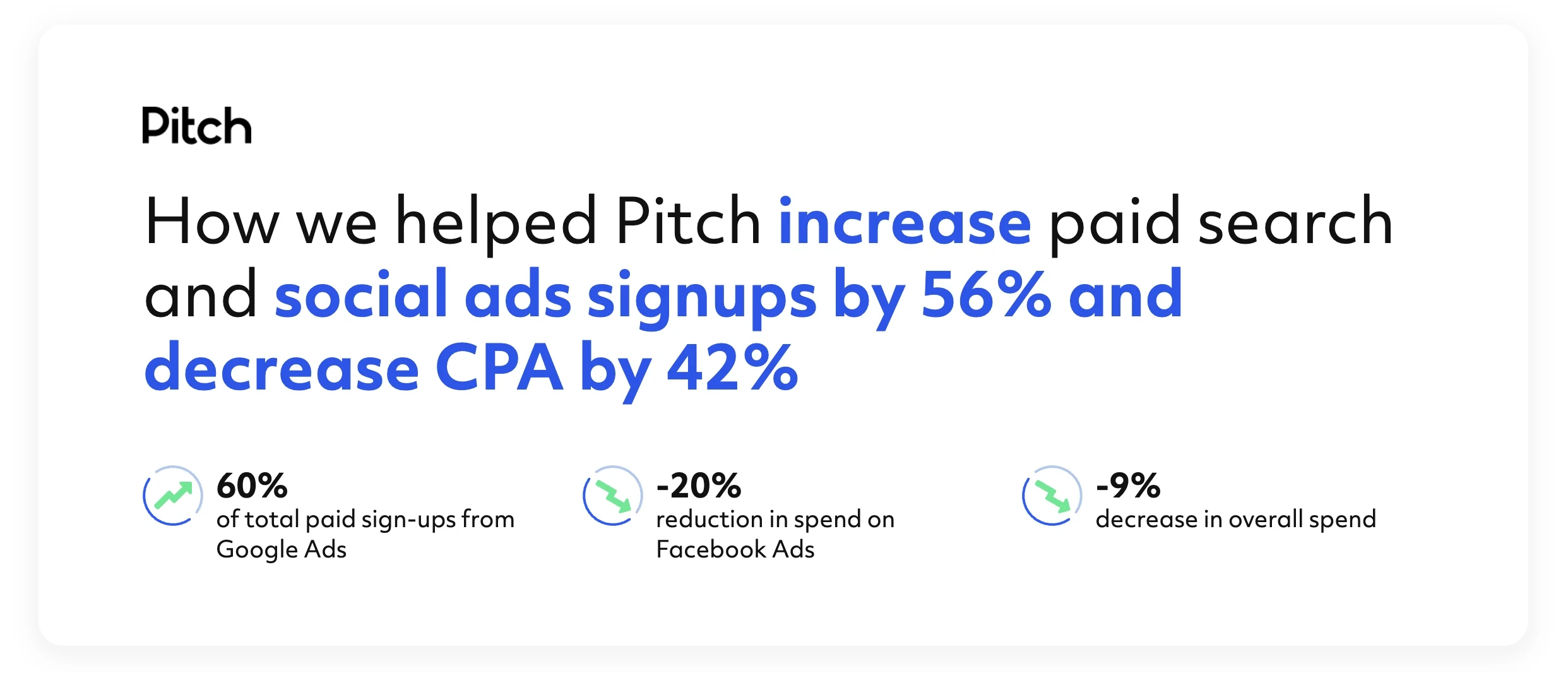
56% increase in signups
42% reduction in CPA
9% reduction in overall spend
60% of paid signups driven by Google Ads
Paid acquisition became both more efficient and more scalable, with Google emerging as a major contributor to growth after previously underperforming.
Key Takeaway
Growth doesn’t always come from adding new channels. It comes from unlocking performance in the ones you already have. With the right strategy, even underperforming channels can become primary drivers of acquisition.
What These SaaS PPC Campaigns Have in Common
Across each of these campaigns, the same patterns show up.
Clear ICP and targeting. Performance improved when campaigns focused on well-defined audiences. In each case, tighter targeting led to higher-quality traffic and better conversion outcomes.
Structured experimentation. Results came from consistent testing and iteration. Campaigns improved over time because creative, targeting, and channels were continuously refined based on performance.
Channel diversification. Growth accelerated when teams moved beyond a single channel. Search, social, and retargeting each played a role in capturing and generating demand.
Creative and messaging alignment. Performance increased when ads clearly communicated value and matched user intent. Refreshing creative and improving messaging directly impacted engagement and conversion.
Focus on commercial outcomes. Success was measured by pipeline, deal value, and efficiency. This made it possible to scale campaigns confidently while maintaining strong returns.
Work With Hey Digital To Scale Your SaaS’ PPC
Scaling paid acquisition in SaaS requires more than running ads. It depends on clear targeting, strong creative, structured experimentation, and alignment with pipeline and revenue.
Hey Digital works exclusively with B2B SaaS companies to build PPC programs that generate qualified pipeline and support efficient growth. Campaigns are structured around how SaaS buyers convert, combining demand capture through search with demand generation across social and retargeting.
Every part of the process is tied to commercial outcomes, including CAC, payback, and deal value. With experience across 200+ SaaS companies, Hey Digital brings a focused, performance-led approach to paid acquisition.
If you’re looking to improve results or scale an existing program, speak to Hey Digital today.

CEO @ Hey Digital
About the author
Dylan Hey is the CEO and co-founder of Hey Digital and Hey Design, where he helps SaaS companies scale through performance marketing and creative strategy. He has built a globally distributed agency working with 200+ SaaS brands.
View LinkedIn
Blog