Building a Google Ads Strategy for SaaS That Drives Pipeline

•

Many SaaS teams launch Google Ads campaigns, see early traction, and then hit a ceiling. Cost per acquisition climbs, lead quality drops, and revenue impact becomes harder to prove.
We’re here to tell you the issue isn’t the platform – it’s the strategy behind it.
A high-performing Google Ads program for SaaS looks different from PPC execution. It needs to align with long sales cycles and complex buying journeys. That means going beyond keyword targeting and thinking in terms of demand capture, intent, and pipeline contribution.
This guide breaks down how to build a Google Ads strategy that supports real revenue outcomes, based on what we’ve learned running campaigns for 200+ B2B SaaS companies.
Why Google Ads Still Works for B2B SaaS
Google Ads remains one of the most reliable ways for B2B SaaS companies to generate pipeline because it sits much closer to the point of intent.
Buyers are actively searching for solutions, comparing vendors, and evaluating options. That changes the economics completely.
For SaaS companies with clear positioning and a defined ICP, this creates a direct path from search to pipeline.
High-intent traffic converts differently
Search traffic behaves differently from most other acquisition channels.
The user already understands the problem
They are actively exploring solutions
They are closer to making a purchase decision
This means conversion rates, sales velocity, and deal quality tend to be stronger when campaigns are structured correctly. (Though that only holds true when you align targeting and measurement with actual revenue outcomes.)
Demand capture supports the entire funnel
A common misconception is that Google Ads only supports bottom-of-funnel activity. In reality, it plays a role across the full buyer journey.
Bottom of funnel: “best [category] software”, “pricing”, “alternatives”
Mid funnel: use-case or problem-led searches
Top of funnel: early research and education queries
Each of these requires a different approach to keywords, messaging, and landing pages.
It compounds with other channels
Google Ads works great as part of a marketing stack. We often see that strong performance comes from companies that are already investing in demand generation through channels such as paid social, content, or outbound. These channels create awareness, while Google Ads captures the resulting demand.
This is why branded search volume and non-brand performance tend to improve as broader marketing efforts scale.
The caveat: it only works when fundamentals are in place
Google Ads is not a shortcut to pipeline.
It works best when three conditions are met:
There is real demand in the market
The product can genuinely solve the problem being searched for
The pricing supports sustainable acquisition economics
When those fundamentals are in place, Google Ads becomes one of the most efficient and scalable ways to turn existing demand into qualified pipeline.
When Should SaaS Companies Invest in Google Ads
Many SaaS companies invest too early in Google Ads, and the result is predictable: rising spend, low-quality conversions, and limited pipeline impact.
There are three clear signals that a company is ready to invest:
There is existing demand to capture. Your ICP is already searching for solutions like yours. You can see this in category keyword volume, competitors bidding on those terms, or early organic traffic coming through high-intent queries.
The product is ready to serve that demand. Your positioning, messaging, and sales process align with what buyers expect when they search. If there is a disconnect, conversion rates drop, and CPAs increase.
The unit economics make sense. You have enough deal value and margin to support paid acquisition. That includes a realistic CAC relative to LTV and the ability to optimize toward revenue, not just leads.
How to Build and Optimize a Google Ads Strategy for SaaS
A strong Google Ads strategy for SaaS needs to be built around intent, data, and revenue outcomes.
That’s because the goal is not to generate more leads. Your aim should be to generate pipeline that converts into revenue, and to give Google the right signals to optimize toward that outcome.
1. Define pipeline-focused goals and conversion actions
Start with what actually matters: revenue.
Many SaaS accounts are set up to optimize for demo requests or free signups. That tends to drive volume, but not necessarily pipeline.
A better approach is to connect Google Ads to CRM outcomes. For example, instead of optimizing toward “demo booked,” you optimize toward “demo attended and qualified” or “opportunity created.” That changes who Google targets.
Once that data is flowing back into the platform, bidding strategies can prioritize users who are more likely to become customers, not just convert on a form.
2. Structure campaigns around intent and funnel stage
Someone searching “best payroll software for startups” has very different intent from someone searching “what is payroll software.” Grouping these together always leads to weaker performance.
A more effective structure separates:
High-intent commercial queries
Problem or use-case searches
Early-stage research
Each gets its own campaigns, messaging, and landing pages. That alignment improves relevance and conversion rates, while giving you clearer performance data.
3. Build a keyword strategy around high-intent search
Keyword strategy should start where buying intent is strongest.
That usually includes category terms, comparison queries, and competitor-related searches. For example, a company selling analytics software might prioritize:
“product analytics tools”
“Mixpanel alternatives”
“best analytics platform for SaaS”
From there, you can expand into mid-funnel queries once you have consistent performance. These are typically more problem- or use-case-driven, such as:
“how to improve product adoption”
“reduce churn SaaS”
“track user behavior in SaaS apps”
“product analytics for onboarding”
Control matters just as much as expansion. Reviewing search term reports regularly and adding negative keywords prevents spend from drifting into irrelevant areas like job searches, definitions, or unrelated use cases.
4. Align ad messaging with real buyer pain points
Ad copy should reflect why someone is searching, not just what your product does.
If a user searches “reduce churn SaaS,” an ad that leads with “all-in-one customer platform” isn’t going to resonate. An ad that speaks directly to reducing churn, improving retention, or identifying at-risk users will perform better.
Take a look at the copy variations we ran for a recent client:
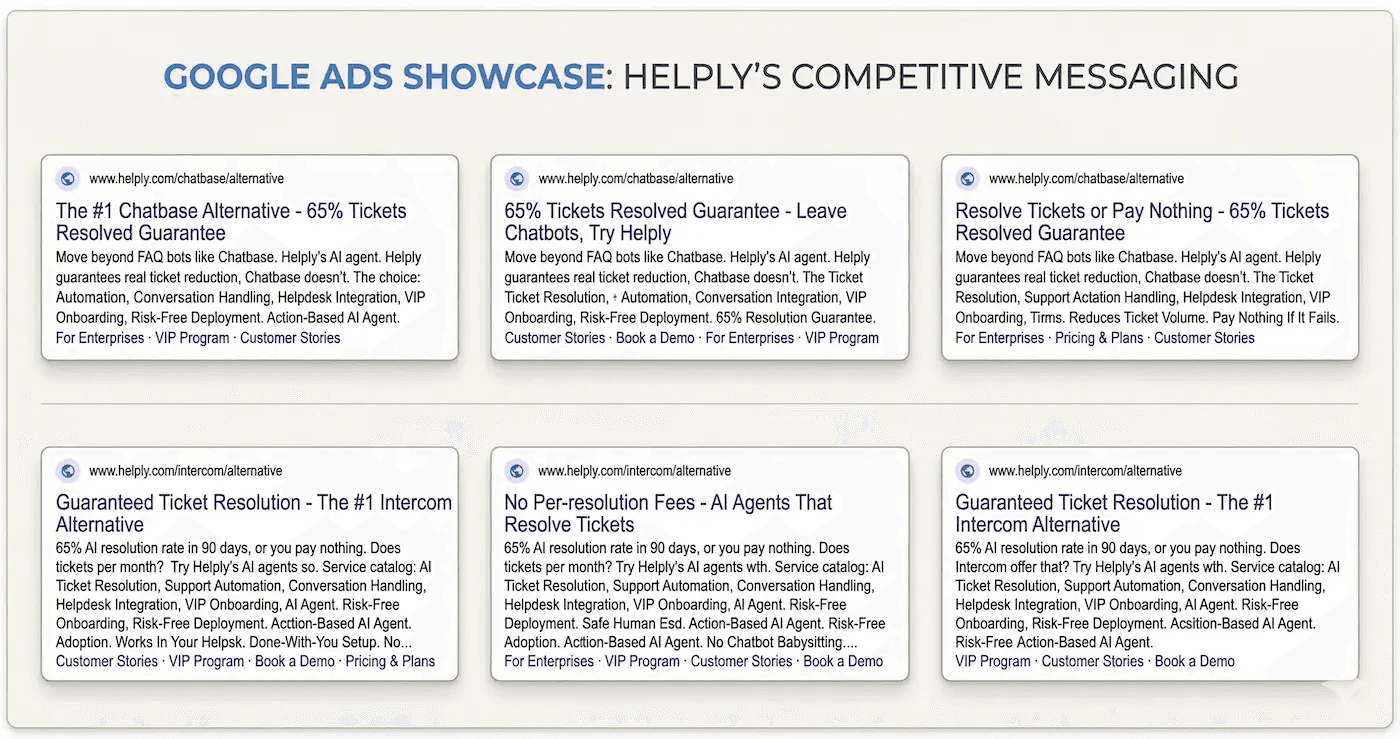
The closer your messaging matches the intent behind the query, the higher the quality of traffic you generate.
5. Create landing pages designed to convert qualified demand
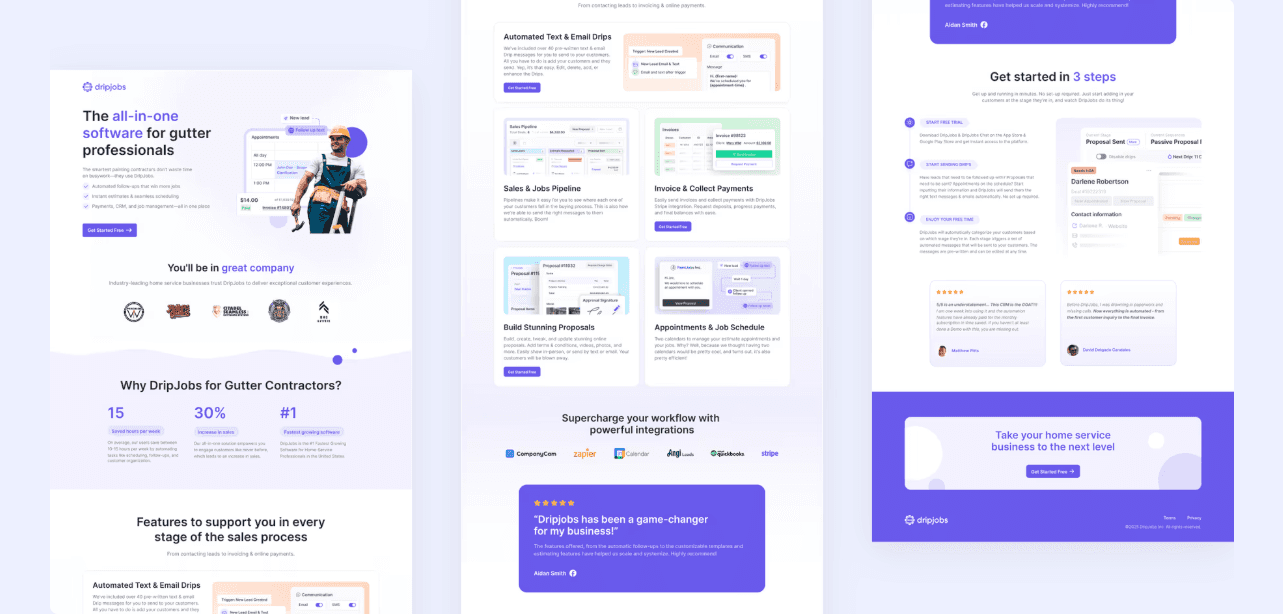
Landing pages should continue the conversation started in the ad.
Sending all traffic to a single generic product page creates friction, and as mentioned a minute ago, breaks the alignment.
A high-intent query like “HubSpot alternatives” should land on a comparison-style page that addresses switching concerns and positioning. A mid-funnel query might need more context, such as use cases or problem framing.
This alignment improves conversion rates and filters out users who are not a good fit. Here’s a range of landing pages we created that are good examples of building to match the audience (in this case, gutter professionals).
6. Segment brand, non-brand, and competitor campaigns
Not all demand behaves the same, so it should not be managed the same way. Think of it this way:
Brand campaigns capture existing demand and deliver the most efficient conversions.
Non-brand campaigns generate new demand but require tighter control.
Competitor campaigns can drive pipeline, but they tend to be more expensive and need careful messaging.
Here’s what the split looked like for a recent client:
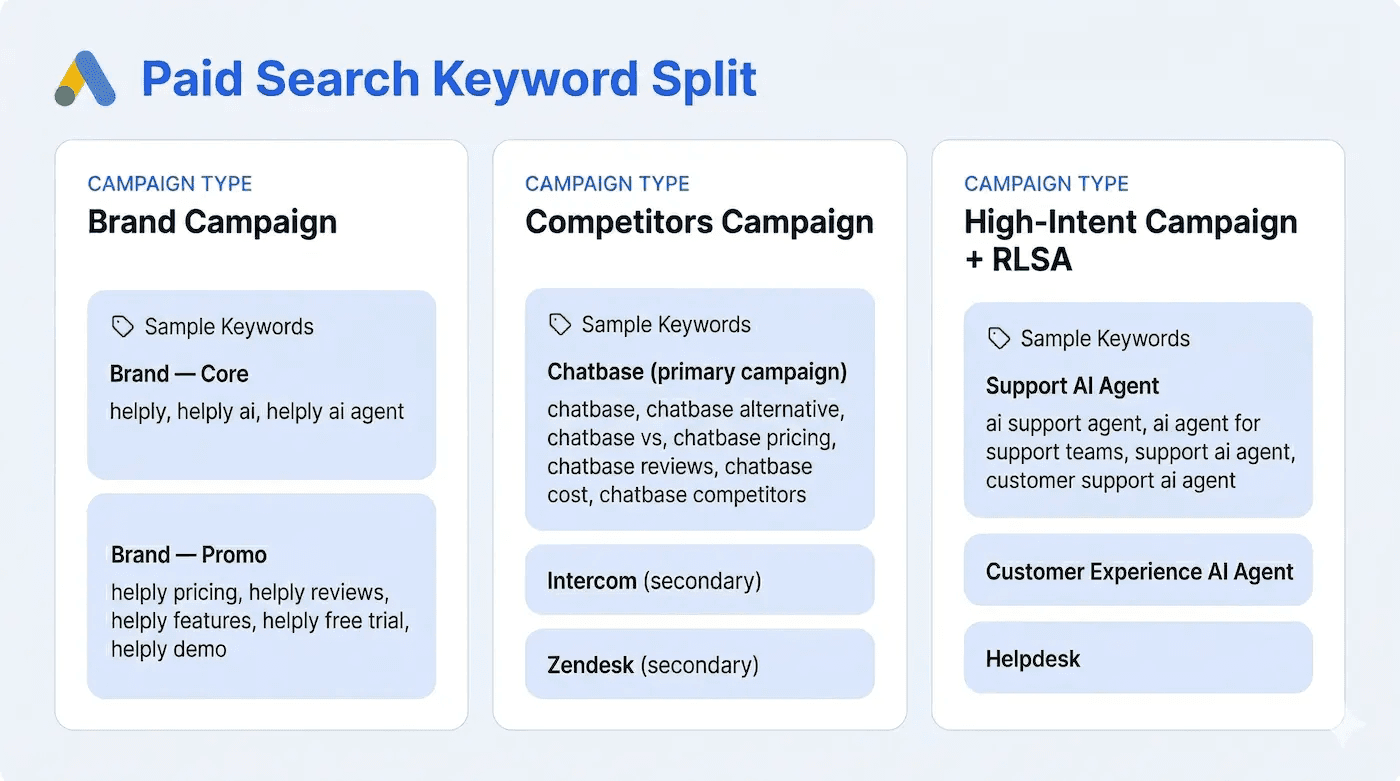
Separating these gives you better visibility into performance and more control over budget allocation.
7. Layer audiences to improve targeting and bidding
Search intent is powerful on its own, but audience signals add another layer of precision.
For example, you might bid more aggressively on users who are already on your remarketing list or part of an in-market audience relevant to your category.
Over time, this helps prioritize higher-quality users without limiting reach too early.
8. Implement remarketing across search and display
Most SaaS buying journeys are not linear, and users rarely convert on the first visit.
Remarketing allows you to stay visible as they continue their research. Someone who visited a pricing page can be retargeted with more direct, conversion-focused messaging. Someone who only viewed a blog post may need more education.
This keeps your brand top of mind and increases the likelihood of conversion over time.
9. Feed offline conversion data back into Google Ads
This is one of the most important steps for SaaS companies, and of course, for building an effective Google Ads strategy.
If Google only sees form fills, it optimizes for form fills. If it sees which leads turn into qualified opportunities or customers, it optimizes for those instead.
For example, if 50 demo requests turn into 10 qualified opportunities, feeding that data back helps Google identify the patterns behind those 10, not the full 50.
That shift improves lead quality, reduces wasted spend, and creates a more scalable system.
Scaling Google Ads Without Breaking Efficiency
Scaling Google Ads in SaaS is not just about increasing spend. It is about increasing spend without degrading lead quality or inflating CPA.
Most accounts become inefficient at this stage because they expand too quickly, introduce automation too early, or move away from what is already working.
A more controlled approach keeps performance stable while unlocking growth.
Increase spend on proven campaigns and segments
Start with what is already driving pipeline.
If certain campaigns, keywords, or audiences consistently generate qualified opportunities, scale them first. This could mean increasing budgets, loosening bid constraints, or expanding coverage within the same theme.
For example, if “best [category] software” keywords are producing strong pipeline, increasing spend there will almost always outperform launching entirely new, untested campaigns.
Scaling works best when it builds on validated signals rather than replacing them.
Expand into new keywords and audiences carefully
Growth comes from expansion, but it needs to be controlled.
Instead of opening up large sets of new keywords at once, expand in focused increments. That might include:
Moving from high-intent to mid-funnel queries
Testing closely related use cases or vertical-specific terms
Introducing new audience layers gradually
Broad expansion without guardrails tends to dilute performance and make optimization harder.
Continuously test creative and landing pages
Scaling is not just a targeting exercise. Creative and landing pages play a major role in maintaining efficiency.
As you increase spend, you reach new segments of your audience. Messaging that worked at lower scale may not resonate in the same way.
Ongoing testing should focus on:
Different value propositions and pain points
Variations in headlines and CTAs
Landing page structure and content depth
Even small improvements in conversion rate can offset increases in CPC as you scale.
Introduce Performance Max only when data is ready
Performance Max can support scaling, but timing matters.
It relies heavily on conversion data to find the right users. Without enough high-quality signals, it tends to prioritize volume over quality.
Before introducing PMax, you should have:
Consistent conversion data tied to pipeline or revenue
Clear visibility into which campaigns and queries perform best
Stable CPA at your current level of spend
Once those conditions are met, PMax can help extend reach and uncover incremental opportunities. Without them, it usually accelerates spend without improving outcomes.
How Hey Digital Builds and Scales Google Ads for SaaS
At Hey Digital, we build Google Ads strategies around pipeline that converts into revenue.
Here’s how we approach it:
Optimizing for pipeline, not leads. We connect Google Ads to CRM data and optimize toward sales-qualified leads, opportunities, and revenue, not just form fills.
Structuring campaigns around real buyer intent. We separate high-intent, mid-funnel, and research-driven queries so messaging, targeting, and landing pages match how SaaS buyers actually search.
Scaling what works. We increase budget on proven campaigns and expand carefully into new keywords and audiences, protecting efficiency as spend grows.
Building control before introducing automation. We focus on clean structure, strong data, and clear signals first. Automation, such as Performance Max, is layered in once there is enough high-quality conversion data.
Continuously test and refine. We run ongoing experiments across ad messaging and landing pages to improve conversion rates and maintain performance at scale.
Designing strategies for SaaS growth stages. From Series A companies building pipeline to more mature teams optimizing CAC, we adapt how accounts are structured and scaled.
We have applied this approach across 200+ B2B SaaS companies, including Instantly, PostHog, Toggl, and Hotjar. We also run paid ads for our own pipeline, using the same playbooks, platforms, and constraints as our clients. That hands-on experience shapes how we build and scale every account.
If you are building a Google Ads strategy and want a team that understands how to turn spend into pipeline, let's talk.
CEO @ Hey Digital
About the author
Dylan Hey is the CEO and co-founder of Hey Digital and Hey Design, where he helps SaaS companies scale through performance marketing and creative strategy. He has built a globally distributed agency working with 200+ SaaS brands.
View LinkedIn
Blog