Why Are Your Google Ads Not Converting?

•
Google Ads can generate clicks, traffic, and even leads, yet still fail to produce meaningful pipeline.
That is what makes diagnosing performance issues in SaaS PPC so difficult. And that’s an issue. Small strategic mistakes compound quickly in SaaS paid acquisition, reducing conversion rates long before the problem becomes obvious in reporting.
This guide breaks down the most common reasons Google Ads campaigns fail to convert in B2B SaaS, how to diagnose the real issues, and what to change to improve performance.
What Does “Not Converting” Mean in Google Ads?
“Not converting” doesn’t always mean campaigns are generating zero leads. In SaaS Google Ads, conversion problems usually show up in more subtle ways.
Clicks increase, but demo requests stay flat
Leads come in, but don’t become qualified opportunities
Conversion rates decline as spend scales
CPA rises while revenue growth stalls
High-intent traffic lands on the site but does not take action
This is why looking at top-level platform metrics alone is misleading. The real question is whether Google Ads is generating the type of demand that turns into pipeline and revenue.
For some SaaS companies, the issue usually sits at the targeting level. The wrong searches are bringing in low-intent traffic. For others, the problem appears after the click, where weak landing pages, unclear positioning, or poor conversion paths reduce performance.
There are also situations where Google Ads is generating legitimate demand, but slow lead response times, weak qualification processes, or poor sales follow-up reduce conversion rates further down the funnel.
Understanding where the drop-off happens is what allows SaaS teams to diagnose the real issue instead of treating symptoms inside the ad platform.
Why Your Google Ads Are Not Converting
After working with 200+ B2B SaaS companies, we’ve seen the same conversion problems appear repeatedly. Most are not caused by Google Ads itself, but by issues across targeting, campaign structure, landing pages, conversion tracking, and sales alignment.
Below are the most common reasons SaaS Google Ads campaigns fail to convert.
You Are Targeting Keywords With the Wrong Intent
High click volume can look encouraging, but informational searches rarely convert at the same rate as commercial or solution-aware queries. A SaaS company bidding on broad terms such as “sales tips” or “marketing automation” may generate traffic while attracting users who are still researching rather than evaluating software.
The problem becomes bigger when broad-match keywords expand into unrelated searches over time.
Here’s a look at how we broke this up for a recent client strategy:
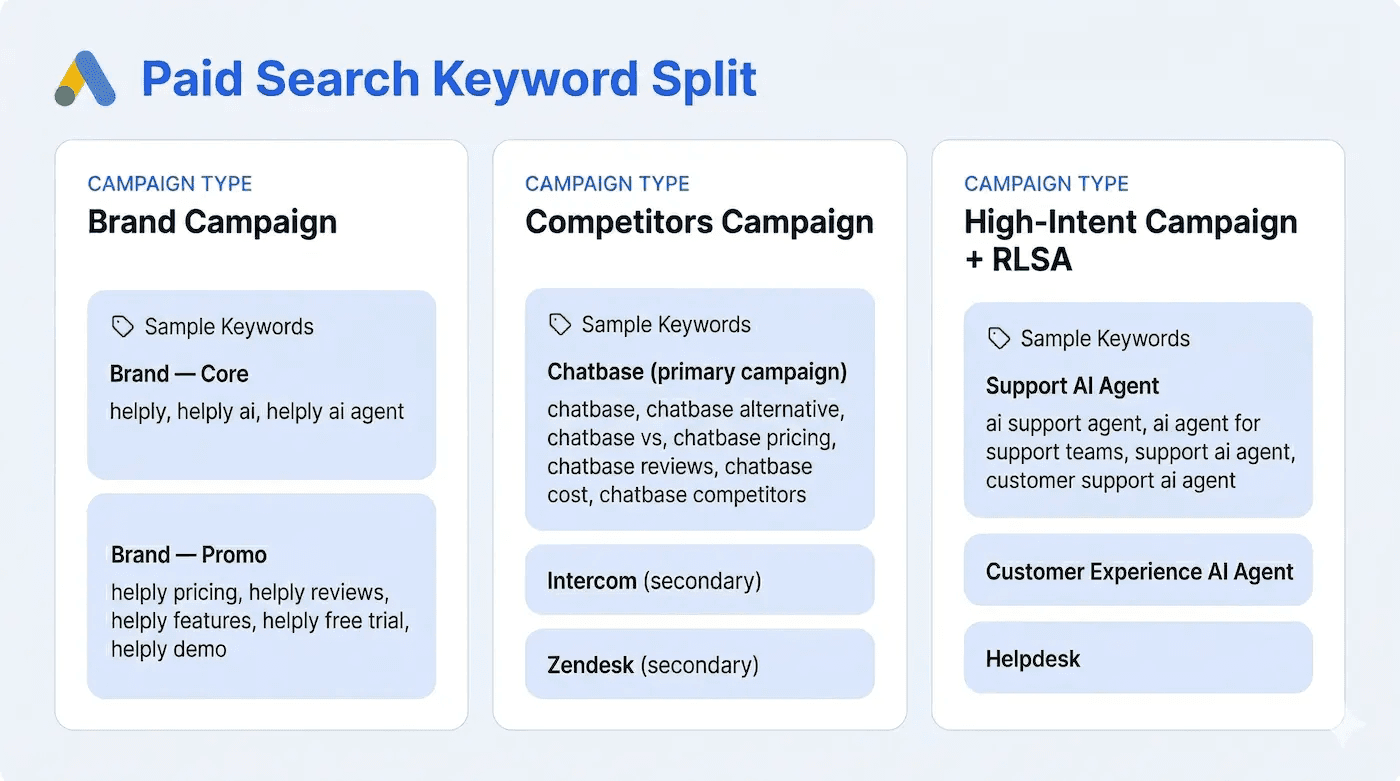
High-converting SaaS campaigns usually prioritize intent-heavy queries first:
“[category] software”
“[competitor] alternatives”
“[problem] solution”
pricing and comparison searches
The closer the keyword sits to active evaluation, the higher the likelihood of conversion.
Your Campaigns Mix Too Many Search Intents Together
Many SaaS Google Ads accounts become difficult to optimize because every type of search gets grouped into the same campaigns.
Someone searching “CRM software pricing” is much closer to a decision than someone searching “how to manage customer relationships.” Yet both searches frequently trigger the same ads, bidding strategy, and landing pages.
This creates mixed signals inside the account. Google struggles to understand which users are most valuable, while ad messaging becomes too broad to resonate strongly with either audience.
Separating campaigns by intent stage creates cleaner optimization signals and improves conversion rates.
Your Offer Doesn’t Match the Buyer’s Stage
Conversion problems aren’t always caused by targeting. Sometimes the traffic is relevant, but the offer asks for too much too early.
For example, a cold prospect who clicks on an educational search query may not be ready to book a sales demo immediately. At the other end of the funnel, someone searching “[competitor] alternatives” usually expects a fast path to evaluation, pricing, or product comparison.
When the offer doesn’t align with the buyer’s stage, friction increases and conversion rates decline.
Strong SaaS campaigns reduce that friction by aligning the conversion path with intent. Informational searches may convert better through guides or webinars, while high-intent commercial queries usually need direct-response landing pages focused on demos, trials, or comparisons.
Your Ad Copy Describes the Product Instead of the Pain
A lot of SaaS ad copy focuses on features before the buyer has decided the product is relevant.
Headlines stuffed with phrases such as “AI-powered workflow automation” or “all-in-one analytics platform” may describe the software, but they don’t connect with the reason someone searched in the first place.
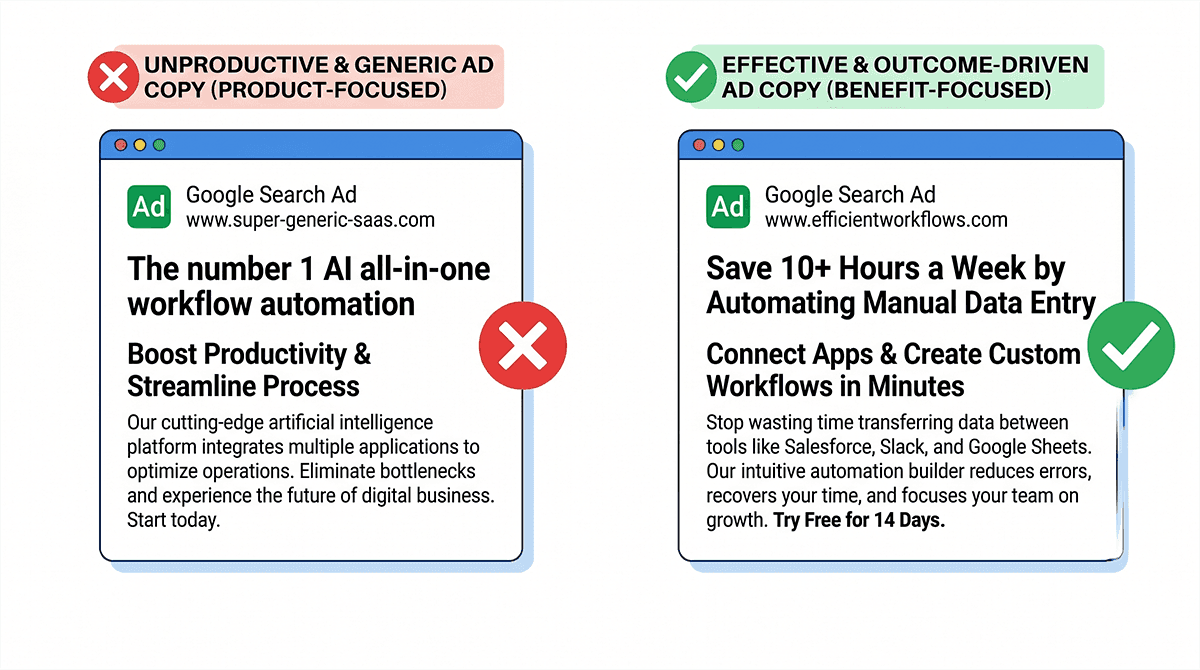
Search intent usually starts with a problem:
Slow reporting
Missed leads
Rising support volume
Poor visibility into performance
Ads convert more effectively when they reflect that underlying frustration before introducing the product itself.
The strongest SaaS campaigns frame the pain first, then position the software as the solution.
Your Landing Page Doesn’t Match the Search Intent
Even well-targeted Google Ads campaigns struggle when the landing page breaks the momentum created by the search.
A user clicking a competitor comparison ad expects to see a comparison page. Someone searching for pricing expects fast access to pricing information. Yet many SaaS campaigns still send all paid traffic to the homepage.
This disconnect creates friction immediately after the click.
Landing pages perform better when the messaging continues naturally from the ad itself. The headline, positioning, CTA, and proof points should all reinforce the reason the user searched in the first place.
The closer the landing page aligns with the user’s intent, the easier it becomes for visitors to take action.
Your Conversion Tracking Is Sending Google the Wrong Signals
Google Ads can only optimize around the conversion data it receives.
If the account is tracking shallow actions such as page visits, low-quality sign-ups, or unqualified leads, Google will naturally try to generate more of those users, even if they don’t turn into customers.
The problem becomes worse when tracking is incomplete or inaccurate. Missing CRM integrations, duplicated conversions, or poorly configured attribution can all distort optimization decisions.
Higher-performing SaaS accounts usually feed Google stronger downstream signals, such as sales-qualified leads or booked demos. The better the conversion signal, the more effectively Google can identify users who are genuinely likely to convert.
Your Negative Keyword Strategy Is Incomplete
Google Ads campaigns naturally expand over time, especially when broad match keywords and automated bidding are involved.
Without regular negative keyword management, campaigns can begin appearing for searches that look loosely related but have very little commercial intent. A SaaS CRM company, for example, might start showing for searches related to templates, definitions, jobs, or support queries that were never meant to be targeted.
You might even start showing for terms that seem logical, but doesn’t align with what your business does or offers. For example, we block bidding on Amazon related keywords in Hey Digital’s own Google Ads as we don’t offer this as a service:
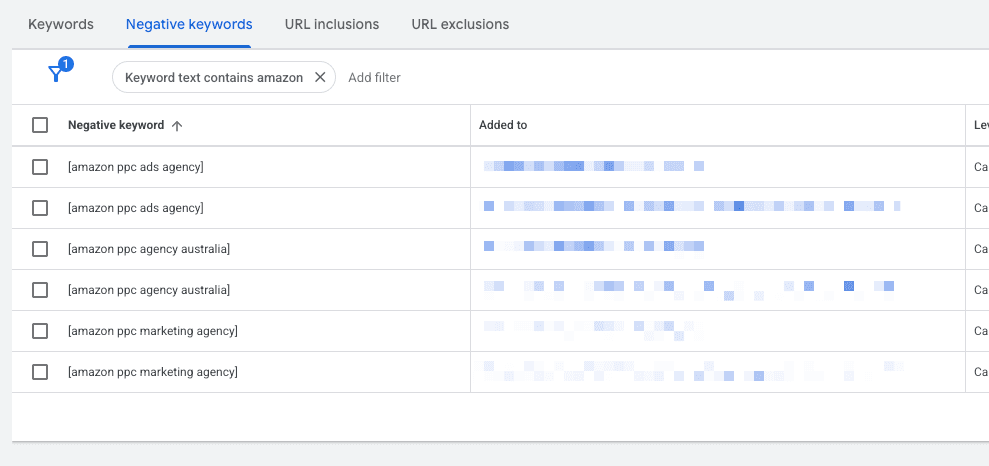
This wasted spend builds gradually, which is why many accounts look efficient early on and decline later as search query quality drifts.
Regular search query reviews help keep campaigns focused on searches that are actually capable of generating qualified pipeline.
Your Campaigns Don’t Have Enough Stable Data to Optimize
Some SaaS teams spread budget across too many campaigns, audiences, and experiments. Others make major account changes every few days before enough data exists to understand what is actually working.
Both create the same problem: unstable optimization signals.
Google’s bidding systems need consistent conversion data. When campaigns reset constantly, or budgets are fragmented across too many variables, performance becomes volatile and difficult to diagnose.
This is especially important in B2B SaaS, where conversion cycles are longer and meaningful conversion volume accumulates more slowly. Patience and structured testing outperform constant reactive changes.
Your Sales Process Is Leaking the Conversions You Generate
Sometimes Google Ads is doing its job correctly, but the problem appears after the lead enters the funnel.
Slow response times, unclear qualification processes, weak demo calls, or poor follow-up can all reduce conversion rates further downstream. From the ad platform’s perspective, campaigns may appear healthy while revenue performance tells a different story.
A campaign that generates high-quality demo requests can still look unprofitable if leads sit untouched for days or if sales teams lack a clear process for converting demand into opportunities.
That is why strong SaaS PPC measurement needs to connect ad performance with CRM outcomes, pipeline progression, and closed revenue, not just platform-level conversions.
How to Diagnose and Fix Google Ads That Are Not Converting
Most SaaS Google Ads problems become much easier to solve once you identify where conversion quality starts to break down.
That usually means auditing the account in sequence instead of changing everything at once.
A strong diagnostic process typically looks at:
Do the keywords reflect genuine buying intent
How campaigns are segmented by search intent and funnel stage
Is the ad messaging aligned with the buyer’s pain points
How closely do the landing pages align with the original search
The quality of trust signals and conversion paths on-page
Is Google optimizing toward meaningful downstream conversions
Search query quality and negative keyword coverage
Whether campaigns have enough stable data to optimize properly
How leads progress through the CRM and sales pipeline
The goal is to understand which parts of the acquisition funnel are reducing the likelihood of turning demand into revenue.
That is the approach we use when building and scaling Google Ads for B2B SaaS companies.
How Hey Digital Builds and Scales Google Ads for SaaS
At Hey Digital, every Google Ads strategy starts with intent and ends with revenue.
We work exclusively with B2B SaaS companies, from Series A teams building their first scalable paid acquisition engine to more established companies restructuring campaigns that have stopped producing efficient pipeline.
That means focusing on the areas that have the biggest commercial impact:
Search intent and keyword quality
Campaign structures aligned to funnel stage
Landing pages built around conversion intent
Optimization toward qualified opportunities and revenue signals
Measurement connected directly to CRM outcomes
Most importantly, we avoid treating Google Ads as an isolated platform metric exercise. Conversion rates, CPA, and click volume only matter if they translate into real business growth.
This approach has been applied across 200+ SaaS companies, including PostHog, Instantly, Toggl, and Hotjar.
If your Google Ads campaigns are generating traffic without producing meaningful pipeline, reach out to us today to see how we can help.
CEO @ Hey Digital
About the author
Dylan Hey is the CEO and co-founder of Hey Digital and Hey Design, where he helps SaaS companies scale through performance marketing and creative strategy. He has built a globally distributed agency working with 200+ SaaS brands.
View LinkedIn
Blog