How to Scale Google Ads for SaaS (And Stay Profitable)

•

Scaling Google Ads in SaaS sounds simple. Increase the budget, capture more demand, and generate more pipeline.
The kicker? Most accounts don’t scale that way.
Instead, as spend increases, CPA climbs, conversion quality drops, and campaigns drift toward lower-intent traffic.
The issue is usually the account structure behind the campaigns.
This guide breaks down how we scale Google Ads for SaaS without losing profitability, based on the frameworks we use across 200+ B2B SaaS companies.
Why Scaling Breaks Most SaaS Google Ads Accounts
Most SaaS Google Ads accounts are built to prove the channel works, not to support larger-scale spend.
At lower budgets, broad targeting and loosely structured campaigns can still produce acceptable results. Once spend increases, those weaknesses become much more visible. Budgets drift toward lower-intent searches, bidding becomes less efficient, and conversion signals get noisier.
Many teams respond by changing bid strategies or increasing automation. That won’t change anything because the problem isn’t bid strategy. The real issue is structural.
The principle is simple: Every meaningful increase in budget should come with a corresponding increase in structural specificity.
Lock In What’s Working Before You Scale
Before adding anything, SaaS businesses need to isolate the campaigns, keywords, and audiences already driving qualified pipeline.
Scaling on surface-level conversions is one of the fastest ways to lose efficiency. Form fills and free sign-ups can make campaigns look healthy while hiding weak lead quality underneath.
The stronger approach is connecting Google Ads performance to CRM outcomes such as:
Qualified opportunities
Pipeline creation
Revenue
Before scaling spend, SaaS teams should use this quick pre-scale checklist:
Stable CPA at the current budget level
Clearly identified winning segments
Reliable conversion data tied to downstream outcomes
Without those foundations, scaling just buys more of the same unfiltered noise.
Our Proven Strategies for Scaling Google Ads in SaaS
Scaling Google Ads profitably comes from improving the structure within the account before introducing entirely new channels or campaign types.
The first goal is to make intent segmentation cleaner, attribution clearer, and optimization signals stronger.
From there, new campaign layers and testing frameworks can expand reach without reducing conversion quality.
Sharpen the splits inside what you already run
The first scaling opportunities usually exist inside the campaign types already running in the account.
As budgets increase, broader campaign groupings start hiding performance differences between search intents. Higher-intent queries become less efficient because budget gets absorbed by larger pools of medium-intent traffic.
One of the most effective scaling moves is splitting campaigns into narrower intent categories.
Split Brand into two ad groups. Pure Brand (defending your name) and Brand Promo (capturing branded searchers exploring offers, pricing, alternatives). They behave differently and should be managed separately.
Split Generic into High Intent and Medium Intent campaigns. High Intent covers category, comparison, and "best [X] software" queries. Medium Intent covers problem and use-case queries where the buyer is in consideration. Folding these together suppresses High Intent performance because Medium Intent volume eats the budget.
Expand Competitor campaigns to cover the top 10 competitors, each with its own ad group. At lower budgets, you might cover one or two. As you scale, structured coverage across the competitive set turns competitor search into a real pipeline lever instead of a vanity play.
These splits give Google cleaner optimization signals while also improving attribution and budget control internally.
Importantly, this type of restructuring improves efficiency before additional spend is introduced. It is one of the lowest-risk ways to scale a SaaS Google Ads account.
Add structured campaign types
Once the core campaign splits are working efficiently, the next step is adding the campaign types that the lower-tier setup didn't justify.
Dynamic Search Ads (DSA) are one example. This is where Google will match a user’s search to the best page on your site, then dynamically generate the ad copy.
In SaaS accounts, DSAs can work well as a structured discovery layer, helping uncover long-tail and emerging searches that are not yet covered inside the manual keyword strategy.
The key is keeping the setup controlled:
Tight page targeting
Aggressive negative keyword management
Ongoing search query reviews
Without those controls, DSA campaigns can drift quickly into low-intent traffic.
Retargeting Lists for Search Ads (RLSA) also become more valuable as accounts scale. When competitors begin bidding on branded terms, prioritizing previous site visitors who search for your brand can help protect conversion efficiency and lower CPA on high-value searches.
Both additions expand reach while maintaining control over structure and intent. That is usually a much safer scaling motion than immediately handing larger budgets to fully automated campaign types.
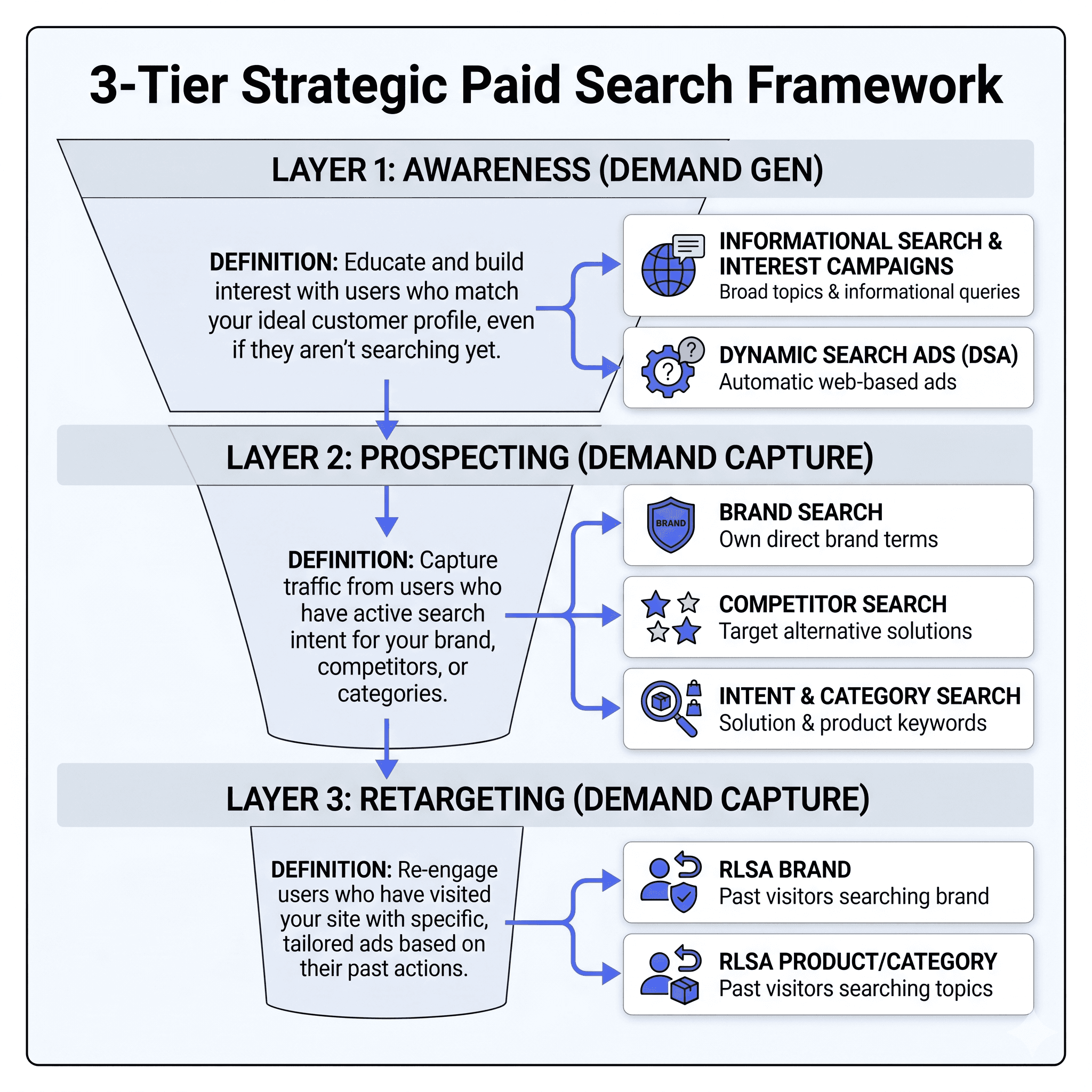
Build the three-layer demand architecture
As SaaS accounts mature, campaign structures usually evolve into three distinct layers, each with a different role inside the buyer journey.
The first layer is awareness and demand generation. This includes lower-intent searches around problems, education, and early-stage research. Informational search campaigns and carefully controlled DSA campaigns can help introduce the brand before buyers reach the active evaluation stage.
The second is a prospecting demand capture layer. This is the core revenue-driving layer made up of:
Pure Brand
Brand Promo
High Intent Generic
Medium Intent Generic
Competitor campaigns
Each campaign type targets a different stage of commercial intent instead of forcing one campaign structure to handle every type of search.
The third layer is retargeting demand capture through RLSA campaigns for both Brand and Generic searches. This keeps the company visible across repeat searches as buyers move closer to conversion.
The advantage of the layered model is clarity. Every stage of intent has a dedicated campaign structure, which improves budget allocation, messaging relevance, and optimization quality as the account scales.
Experiment at every stage
Scaling without testing usually locks the account into its current performance ceiling.
As campaign structures become more sophisticated, the cadence should shift as the account grows:
At the splits stage, test bid strategies and ad copy variants within the new High Intent campaigns
At the new-campaign-type stage, test DSA targeting and RLSA bid modifiers
At the three-layer stage, test landing page variants for each layer and feed learnings back into the others.
The point is that every structural addition opens a new testing surface.
The key is to treat experimentation as an ongoing workstream rather than a one-off optimization task. Every structural addition should create clearer insights that improve performance across the wider account.
Bonus: If You Use Performance Max, Use It Carefully
Performance Max is often presented as the default scaling solution inside Google Ads. For B2B SaaS, we tend to be more cautious.
The default scaling motion in our playbook is structured search expansion first. That means focusing on clearer intent segmentation, DSA discovery layers, RLSA campaigns and expanded demand capture structures. This provides more visibility and stronger control over traffic quality before introducing heavier automation.
If Performance Max is used, it should sit alongside a well-structured search account, not replace it.
Most importantly, the conversion data feeding PMax needs to reflect downstream quality. Optimizing toward form fills or shallow sign-ups can quickly push spend toward the wrong users. Revenue-linked conversion signals, CRM integration, and qualified pipeline data are what allow automated campaigns to optimize toward meaningful outcomes instead of surface-level efficiency.
Ready to Scale Google Ads Profitably?
We can’t say this enough – scaling Google Ads in SaaS isn't about pushing more budget into the same campaigns and hoping performance holds up.
The accounts that scale efficiently become more structured as spend increases. Search intent gets segmented more clearly, conversion signals become more precise, and campaign architecture evolves to support different stages of the buyer journey.
That is the approach we use at Hey Digital across 200+ B2B SaaS companies, from Series A teams building their first scalable paid acquisition engine to more mature SaaS brands optimizing efficiency at larger spend levels.
If you want to scale Google Ads without sacrificing conversion quality or profitability, reach out to us.
CEO @ Hey Digital
About the author
Dylan Hey is the CEO and co-founder of Hey Digital and Hey Design, where he helps SaaS companies scale through performance marketing and creative strategy. He has built a globally distributed agency working with 200+ SaaS brands.
View LinkedIn
Blog