SaaS Google Ads Case Study: How Wiza Increased Sign-Ups by 88% While Lowering CPA

•

Scaling Google Ads in SaaS gets harder once early demand saturates. Sign-up growth slows, CPA climbs, and scaling becomes difficult to justify.
That was the challenge Wiza faced.
Wiza already had strong organic traction and an established sales pipeline, but competitors were capturing high-intent search demand on Google. The opportunity was clear: build a paid acquisition strategy that could scale sign-ups without sacrificing efficiency.
Working together, we restructured Wiza’s Google Ads account around search intent, tightened targeting, improved traffic quality, and optimized campaigns around downstream conversion signals.
The result was an 88% increase in sign-ups from Google search while reducing CPA by 7%, even as media spend increased by 73%.
The Challenge: Scaling High-Intent SaaS Search Efficiently
Wiza already had strong organic traction and an established sales pipeline. The challenge was scaling high-intent search efficiently while keeping CPA under control as spend increased.
A few key issues stood in the way:
Competitors were capturing high-intent search demand. Wiza needed stronger visibility on Google for high-intent and brand-related queries before competitors intercepted that traffic.
Campaign structures were difficult to scale efficiently. Existing campaign setups created inefficiencies as budgets increased, making it harder to control CPA while driving more conversions.
Traffic quality mattered as much as sign-up volume. The goal was not just to generate more sign-ups. Wiza needed high-value conversions that were more likely to turn into paying customers.
Audience targeting needed to stay highly specific. Because Wiza’s product is closely tied to LinkedIn Sales Navigator, campaigns needed to focus on users already familiar with that workflow and use case.
To overcome this, the focus was on capturing more high-intent demand, improving conversion quality, and scaling spend without sacrificing efficiency.
The Google Ads Strategy Behind the Growth
Scaling Google Ads efficiently required more than increasing spend. The account structure, targeting, and optimization strategy all needed to support higher conversion volume without driving CPA up alongside it.
We helped Wiza rebuild their campaigns around search intent, traffic quality, and downstream conversion signals.
Restructuring campaigns around search intent
One of the biggest changes was restructuring the Google Ads account around search query intent rather than isolated keywords.
The original setup relied on multiple single-keyword campaigns, which created overlap and made budget management more difficult as spend increased. Match types were also separated across different campaigns and ad groups, increasing the risk of keyword conflicts.
We consolidated campaigns into five intent-based campaign groups and combined match types within the same ad groups. This gave Google clearer signals, improved budget allocation, and reduced competition between campaigns targeting similar searches.
This also then enabled us to build out dedicated landing pages per campaign, like this Zoominfo comparison page:
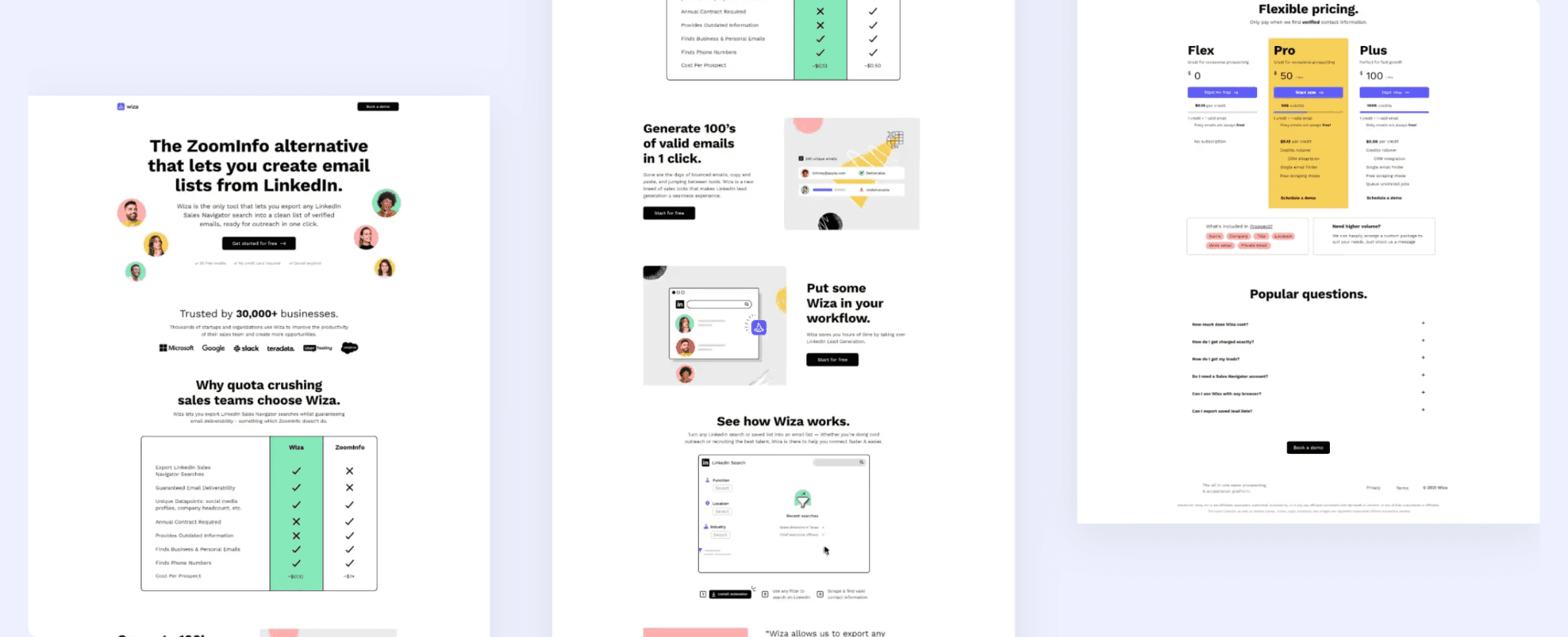
The overall result was a more scalable structure that reduced CPC by 4.4% while increasing clicks by 79%.
Key insight: Structuring campaigns around search intent instead of isolated keywords gives Google clearer optimization signals and makes budget allocation easier to control as accounts scale.
Takeaway: Campaign structures organized around search intent scale more efficiently than fragmented single-keyword setups.
Using negative keywords to improve traffic quality
As ad spend increased, maintaining traffic quality became just as important as scaling volume.
We continuously reviewed search query data and updated negative keyword lists to remove irrelevant or lower-intent searches that were driving wasted spend. This helped tighten the match between user intent and the campaigns being served.
Alongside negative keyword optimization, we refined campaign settings and scheduling to further improve efficiency. Small adjustments at the account level helped improve campaign health and supported stronger CPA performance as budgets scaled.
This ongoing filtering process allowed Wiza to capture more relevant search traffic while protecting efficiency as click volume increased.
Key insight: Ongoing search query reviews help keep campaigns focused on commercial intent instead of informational traffic that is unlikely to convert.
Takeaway: The more a SaaS account scales, the more important ongoing search query management becomes for protecting efficiency.
Expanding into new regions without sacrificing quality
Once campaign efficiency improved, the next step was scaling reach without lowering conversion quality.
Wiza’s campaigns initially focused on a smaller set of core markets. After validating performance, we expanded targeting into additional EMEA and APAC regions where there was clear potential demand.
The key was measuring success based on purchase behavior, not just sign-up volume.
Some regions generated conversions but failed to produce paying customers, so those markets were excluded from the expansion strategy. This allowed spend to stay concentrated in regions delivering stronger downstream results.
Using purchase data as the primary signal gave the team a clearer view of which campaigns and geographies were contributing meaningful growth, making it possible to scale internationally while maintaining efficiency.
Key insight: Expansion becomes risky when scaling decisions are based purely on conversion volume. Purchase and revenue data give a much clearer signal of which regions can support sustainable growth.
Takeaway: Scaling internationally becomes much easier when expansion decisions are tied to purchase quality instead of raw conversion volume.
Optimizing toward purchases, not just sign-ups
As campaigns scaled, conversion quality became a bigger priority.
Some campaigns were generating strong conversion numbers on the surface, but a closer look showed that not every sign-up was turning into a paying customer. Optimizing purely for lead volume risked pushing spend toward lower-quality conversions.
To improve this, optimization goals were shifted toward purchases. Audience targeting and lookalike models were updated to prioritize users more likely to convert into customers, not just complete an initial action.
We see this all the time in SaaS PPC. Platforms optimize aggressively toward the conversion event they receive, even if that event does not reflect customer quality. Feeding stronger downstream signals into the platform improves both targeting and long-term efficiency.
This gave the ad platforms stronger downstream signals and improved the overall quality of conversions entering the funnel.
Key insight: For SaaS companies, this distinction matters. A lower CPA means very little if the traffic acquired does not translate into revenue. Optimizing for purchase intent rather than surface-level conversions creates a much clearer path to efficient growth.
Takeaway: In SaaS PPC, the quality of the conversion signal usually determines the quality of the customer being acquired.
Want to see the impact of our SaaS PPC strategies? Click here to learn more about how we drive pipeline and revenue for clients.
How Hey Digital Builds Google Ads Strategies for SaaS
Google Ads performance in SaaS depends on more than keyword targeting and budget increases. Sustainable growth comes from aligning campaign structure, targeting, and optimization with revenue outcomes.
At Hey Digital, we build Google Ads strategies around search intent and conversion quality from the start. Campaigns are structured to capture high-intent demand efficiently, and optimization decisions are guided by downstream performance signals.
That includes:
Intent-based campaign structures
Ongoing traffic quality refinement
Landing pages aligned to buyer intent
Optimization around qualified conversions and revenue signals
This approach has been applied across 200+ B2B SaaS companies, helping teams scale paid acquisition efficiently as spend grows.
Looking to scale Google Ads in SaaS without sacrificing efficiency? Reach out to us today to see how we can help you increase your trial sign-ups, get high-quality demos with decision-makers, and keep costs under control.
CEO @ Hey Digital
About the author
Dylan Hey is the CEO and co-founder of Hey Digital and Hey Design, where he helps SaaS companies scale through performance marketing and creative strategy. He has built a globally distributed agency working with 200+ SaaS brands.
View LinkedIn
Blog